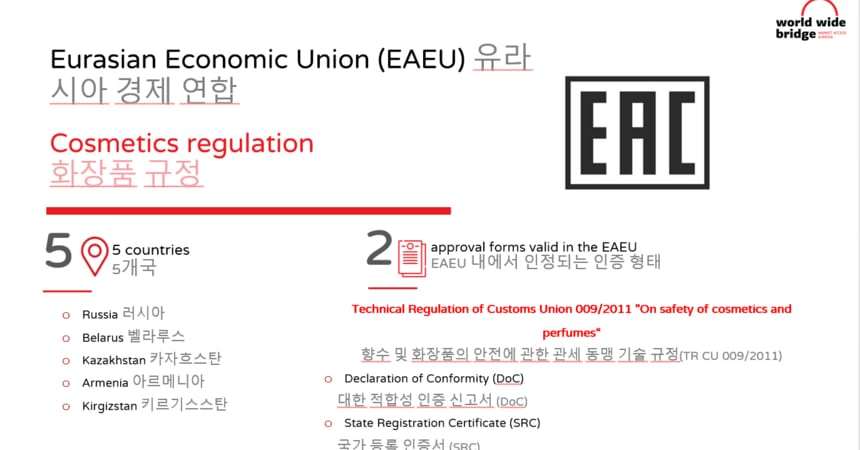
Cosmetics Labelling Requirements for the EAC Mark
A cosmetics label for the Customs Union carries fifteen items, from product name and intended use through to the ingredient list and the EAC sign. Two of them are conditional, colour for decorative products, and fluoride content for oral hygiene.
What must a cosmetics label carry?
| # | Item |
|---|---|
| 1 | Product name |
| 2 | Intended use of the product |
| 3 | Manufacturer’s name and registered address, including country |
| 4 | Country of origin |
| 5 | Name and address of the authorised representative in the Customs Union |
| 6 | Nominal quantity, volume or weight, in the retail packaging |
| 7 | Colour, for decorative cosmetics and colouring agents |
| 8 | Weight content of fluoride (%, mg/kg or ppm), for oral hygiene products |
| 9 | Shelf life |
| 10 | Production date (month, year) and expiry date |
| 11 | Storage conditions, where they differ from standard |
| 12 | Special precautions, where necessary |
| 13 | Serial number or special code identifying the batch |
| 14 | Method of use, where its absence could lead to improper usage |
| 15 | List of ingredients, and the EAC sign |
Which three items deserve a second look?
Item 5, the authorised representative. A product made outside the Customs Union needs a point of contact inside it, and that contact appears on the label itself. It is one of the most common omissions on labels adapted from another market.
Items 7 and 8 are conditional. Colour applies to decorative cosmetics and colouring agents; fluoride content applies to oral hygiene products. Neither belongs on a general-purpose label, and both are mandatory where they apply.
Item 14, method of use. The requirement is triggered by consequence, not by category: the information is required wherever its absence could lead a consumer to use the product improperly, a judgment the manufacturer makes and the regulator can disagree with.
The language rule, and when the label has to exist
Two practical points that the fifteen items do not state on their own.
Language. The information must appear in the state language or languages of the member states where the product is sold. A pack carrying only the manufacturer’s home-market text does not satisfy the regulation however complete it is.
Timing. Products are labelled before import into the Union. Relabelling on arrival is not a planned route, so artwork has to be finished while testing is still running, before the approval document lands.
Where does the EAC mark go, and what about small packs?
The EAC mark goes on each product unit once conformity assessment is complete. The manufacturer applies it; the entitlement comes from the declaration or the State Registration Certificate behind it.
Very small packs get one concession rather than a general exemption: the nominal quantity may be omitted below 5 g or 5 ml. Everything else on the list still applies, which is what makes miniatures, samples and travel sizes disproportionately awkward, the same fifteen items, minus one, on a fraction of the surface. The usual answer is an outer carton or a fold-out label, decided at artwork stage.
Sources
- TR CU 009/2011, On safety of perfumery and cosmetic products, Eurasian Economic Commission, labelling requirements
Frequently asked questions
What must a cosmetics label show?
Product name; intended use; manufacturer's name, registered address and country; country of origin; the authorised representative in the Customs Union with name and address; nominal quantity in the retail pack; shelf life; production date and expiry date; storage conditions where non-standard; special precautions; batch number or code; usage method; the ingredient list; and the EAC sign.
Which requirements apply only to some products?
Two. Colour must be stated for decorative cosmetics and colouring agents. Weight content of fluoride, as a percentage, mg/kg or ppm, must be stated for oral hygiene products.
Which language must the label be in?
The information has to appear in the state language or languages of the member states where the product is sold. It also has to be on the pack before the goods are imported into the Union; labelling after arrival is not a route, so artwork sits on the project's critical path.
Why does the authorised representative appear on the label?
Because it is the point of contact inside the Customs Union for a product made outside it. The name and address of the authorised representative in the Customs Union is a required label field, alongside the manufacturer's own details.
Not sure which of these applies to your product? Send it and we will tell you
Related articles
The EAEU Cosmetics Approval System: Webinar Notes
The ten-part agenda of a WWBridge webinar on entering the EAEU cosmetics market, approval forms, ingredient lists, and the safety indicators assessed.
Cosmetics Approval for the Customs Union: TR CU 009
A declaration per product type under TR CU 009, plus state registration for listed categories. Why compositions in percentage decide the test report count.
ANVISA Cosmetic Certification in Brazil: A Route Map
What ANVISA requires before a cosmetic can be sold in Brazil: the four document sets, the three tests, Portuguese labelling rules and the ingredient limits.