





New Distributor: Who Holds Your Anvisa Cosmetic Registration?
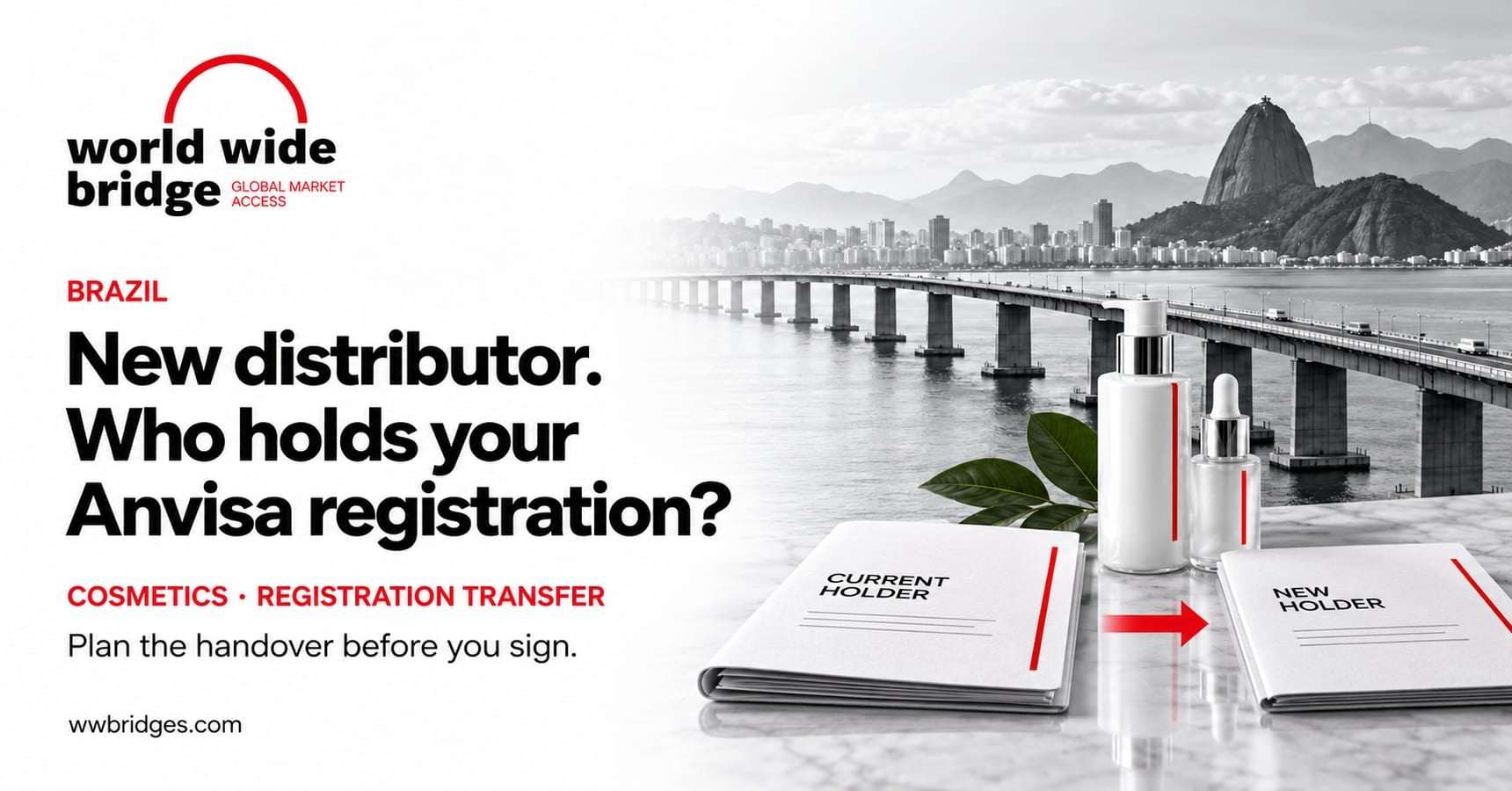
Changing your Brazilian distributor? Xenia explains when an Anvisa cosmetic registration can move, the 180-day filing window and what to agree before signing.
Typical timelineDays for notification, 6 to 12 months for registration
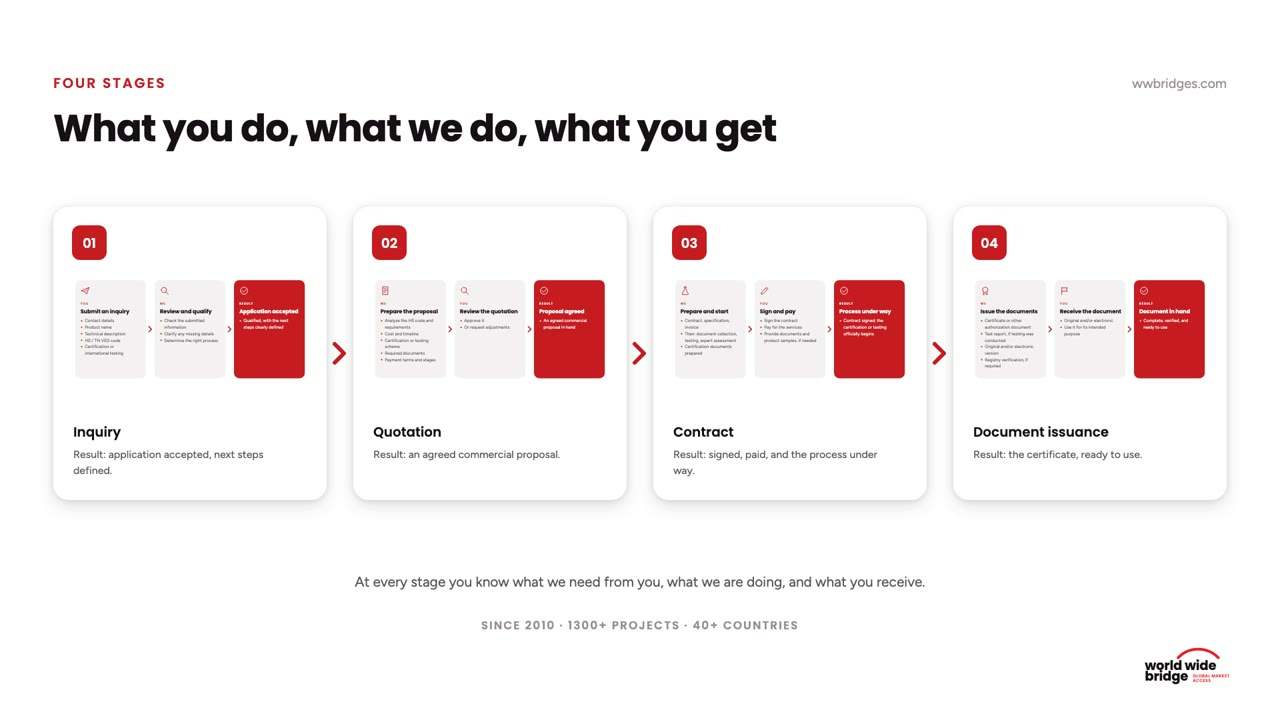

Product name, HS code and technical data, enough for us to scope the route.
Your part
A specialist confirms the regulations that apply and the document type your product needs.
Our part
You send the supporting documents; we sign a contract with fixed scope and timeline.
Both sides
Laboratory testing, factory inspection and customs clearance, coordinated by us.
Our partIssued, registered, and delivered. We close the project.
Your partCosmetic registration in Brazil is governed by ANVISA Resolution RDC 907/2024, which replaced RDC 752/2022. Cosmetic registration in Brazil is governed by ANVISA Resolution RDC 907/2024, which replaced RDC 752/2022 and splits cosmetics, personal-hygiene products and perfumes into two grades. Grade 1 products go to market by electronic notification. Grade 2 products, those with a specific claim or a restricted ingredient, file technical and safety data with the notification, and a listed subset, sunscreens and products for children among them, still goes through registration, a dossier review that takes months. The grade comes from the regulation and the label copy, and one claim can move a product. In every case the holder is a Brazilian company with a CNPJ and an AFE (Autorização de Funcionamento de Empresa) from ANVISA, and finding that holder is often the longest lead item.
RDC 907/2024 splits cosmetics into two grades. A moisturiser without claims is Grade 1. An SPF, an anti-dandruff claim or a restricted ingredient puts the product in Grade 2.
Settle the label copy before the grade, and the grade before printing.
Grade 1 and most Grade 2 products clear by electronic notification in days to weeks. Listed Grade 2 products, sunscreens and children's products among them, wait 6 to 12 months for dossier review.
One word on the label, such as 'anti-wrinkle', can move the grade.
The holder is a Brazilian company with a CNPJ, an ANVISA AFE covering cosmetics import, and a local health licence. It answers to ANVISA for the product and keeps the technical file.
Check the AFE on ANVISA's public consultation before dossier work starts.
The holder sets the critical path most often. The importer lined up has no AFE for cosmetics, or holds one for medical devices, which does not cover them. Other files stop on the formulation: it passes the EU annexes but contains a preservative, colourant or UV filter outside Brazil's own lists. A claim added late moves the product into Grade 2. The EU Product Information File may have gone in without Brazil's structure and Portuguese labelling.
The science comes from you. The formulation with INCI names, the stability data, the safety assessment and the microbiological results exist only inside the manufacturer, and an EU file under Regulation (EC) 1223/2009 supplies most of the evidence for the Brazilian submission. The filing sits with the holder, which answers to ANVISA and keeps the technical file. A change of formulation or claim after filing goes through change control, or through a new submission if the grade moves.
Everything here is something to find before the project starts. The first reply says which of it can go into the file as it is.
One specialist owns your file from the first email to the registered certificate. Every one of them has recorded a briefing on their field.
Each stage is a service of its own, with a page that says what it produces and what it needs from you.
The cheapest stage decides the cost of every stage after it. What a route assessment names, and the four decisions it locks down.
Read the pageAccreditation is per standard and per laboratory, never general. How to choose one the destination accepts, and test once for several markets.
Read the pageThe file is the certificate’s foundation and it is the manufacturer’s to produce. What it has to contain, and what cannot be written retrospectively.
Read the pageAudits turn a schedule from weeks into months and cannot be compressed. What auditors check, and how to be ready for the first visit.
Read the pageFour major markets refuse to certify a foreign manufacturer directly. What the appointment obliges, and why a distributor is the wrong holder.
Read the pageA correct certificate and a wrong label still stops at the border. What each market demands on the artwork, and when to check it.
Read the pageRDC 907/2024 draws the line. Grade 1 covers products whose basic properties do not require detailed proof of safety or efficacy, a shampoo or a moisturiser without claims, and they clear by notification, which ANVISA records without a technical assessment. Grade 2 covers products with a specific purpose or a restricted ingredient: antiperspirants, anti-dandruff shampoos, products for children, anything with an SPF. Most Grade 2 products are notified with their technical data attached. The ones the regulation lists for registration, sunscreens and children's products among them, wait for a dossier review.
A single ingredient or a single claim moves a product upward. "Hydrating" is Grade 1; "anti-wrinkle" or "SPF 15" makes it Grade 2. Settle the label copy before the grade, and the grade before the artwork is printed.
A Brazilian legal entity with a CNPJ, an AFE (Autorização de Funcionamento de Empresa) from ANVISA covering the activity in question, importing cosmetics, and a local health licence (licença sanitária) from the state or municipal vigilância sanitária. An importer without those cannot hold your product however willing it is, and an AFE for medical devices does not cover cosmetics.
The holder is also the legal responsible party. It answers to ANVISA for the product, keeps the technical file and handles recalls. This is the item that sets the critical path most often. Verify the AFE and its listed activities on ANVISA's public consultation before the dossier work starts.
The formulation with INCI names and percentages, the manufacturing process, stability data, the safety assessment, microbiological results and the Portuguese labelling artwork. Most of it exists only inside the manufacturer and is not something a consultant can generate. Where a product is already sold in the European Union under Regulation (EC) 1223/2009, the Product Information File covers most of the science. It does not cover the form: Brazil expects its own structure, its own required statements and Portuguese labelling.
Some restrictions differ. Brazil keeps its own lists of permitted preservatives, colourants and UV filters, so a formulation that passes the EU annexes can still contain something outside the Brazilian list. Check the ingredient lists first. It is the cheapest check in the project and the one that changes the formulation.
The same logic runs through the other categories ANVISA regulates. Medical devices follow RDC 751/2022: Classes I and II are notified, Classes III and IV are registered, and the holder needs an AFE for devices. Food supplements follow RDC 243/2018. The grade or class decides the route, and the route decides the timeline.
| Notification | Registration | |
|---|---|---|
| Applies to | Grade 1, and most Grade 2 with technical data | Grade 2 products listed by RDC 907/2024, such as sunscreens and children's products |
| What ANVISA does | Records the filing | Reviews a technical dossier |
| Typical timeline | Days to weeks | 6 to 12 months |
| Holder | Brazilian company with CNPJ, AFE and health licence | Same |
| Validity | Renewable | Renewable, with change control |
| Medical devices (RDC 751/2022) | Classes I and II | Classes III and IV |
A change of formulation or of claim can move a product from one column to the other. Confirm the grade before the artwork is printed.
No. Notification is an electronic filing under RDC 907/2024 that ANVISA records; registration is a dossier review that takes months and is reserved for a listed group of Grade 2 products such as sunscreens and children's cosmetics. A single restricted ingredient or a single claim can move a product between grades.
Not as a foreign company. The holder must be a Brazilian legal entity with a CNPJ, an AFE from ANVISA for the cosmetics activity, and a local health licence. Check the AFE on ANVISA's public consultation for your exact category before starting the dossier.
The science does. An EU Product Information File under Regulation (EC) 1223/2009 supplies most of the evidence. The form does not: Brazil expects its own dossier structure, its own required statements, its own ingredient lists and Portuguese labelling. Treat the EU file as source material and build the Brazilian submission from it.
It depends on what changed. Minor changes go through change control against the existing filing; a change that alters the grade or introduces a restricted ingredient means a new submission. Reformulation is common, and the regulatory consequence is not proportional to the size of the change.
Changing your Brazilian distributor? Xenia explains when an Anvisa cosmetic registration can move, the 180-day filing window and what to agree before signing.
What Anvisa's RDC 894/2024 asks of a cosmetic brand when a consumer in Brazil complains: who answers, the 20-day and 15-day deadlines, records and recalls.
INMETRO handles equipment and machinery, ANVISA handles cosmetics and health products. Different stages, different validity, and one shared prerequisite.
Send the product name, HS code and technical data. You get back the applicable route, the document list and a timeline, before any commitment.