
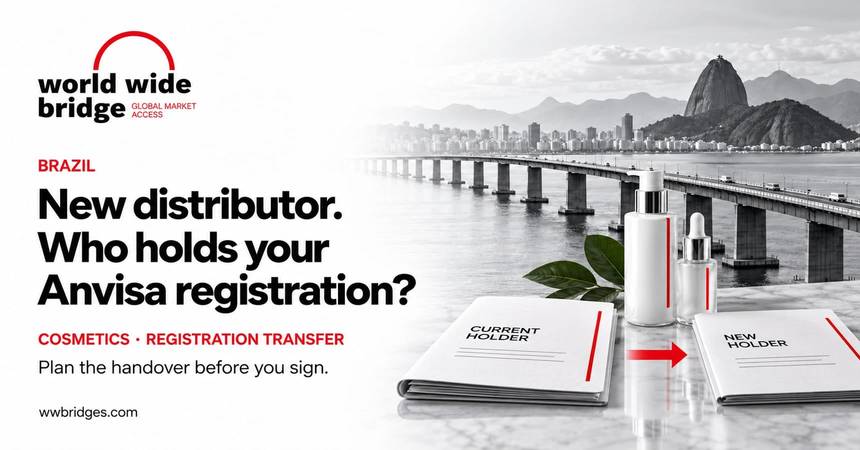
Changing distributors does not automatically change an Anvisa registration holder. RDC 903/2024 provides a transfer route for qualifying corporate or asset transactions, with the product unchanged and coordinated filings within 180 days. Notified cosmetics follow a different route. I would settle the regulatory handover before signing the distribution agreement.
Your brand is on the bottle. Whose company is on the record?
Before I would recommend changing a Brazilian distributor, I would ask to see the Anvisa record for every product. The name on the bottle tells me who owns the brand. The holder named in the regulatory record tells me which company carries the regulatory position we need to examine.
Those can be different companies. If the outgoing distributor holds the registration, signing a new distribution agreement leaves a separate question unresolved: how will the new partner take over the regulatory rights and obligations?
My view is that this belongs in the first commercial discussion. Leaving it until the new partner has ordered stock turns a negotiable handover into an urgent supply problem.
A transfer is possible, but a new sales contract is not enough
RDC 903/2024 covers qualifying corporate and commercial transactions. Its definition of a commercial transaction involves transferring assets or a set of assets. The transfer procedure preserves the product’s technical and sanitary characteristics.
That distinction matters. An agreement appointing a different seller is not automatically the asset transaction required for a registration transfer. I would have the proposed transaction checked against this rule before describing the registration as transferable.
I would also keep a planned formula change out of the handover. Combining a holder change with a product change makes it harder to establish that the transfer conditions are met. Agree the regulatory sequence before changing either.
One boundary deserves its own line: this procedure does not transfer notified cosmetics. Article 28 requires a new notification or the applicable regularisation procedure for the successor. I would confirm registration versus notification before pricing the handover; the commercial team may use “registration” for both.
The 180-day clock is for filing, not approval
For registered cosmetics, Article 26 requires coordinated petitions: the successor requests transfer and the predecessor requests cancellation for transfer. The deadline is up to 180 days from registration of the corporate act or signing of the asset-transfer instrument, as applicable. Late petitions are refused.
Anvisa’s transfer FAQ confirms the coordinated filing requirement. That is why I would not accept “our new distributor will handle everything” without a written commitment from the outgoing holder too.
The 180 days do not tell you when Anvisa will finish. Its cosmetic transfer service gives no estimated completion time. I would not build a launch date around an assumed approval deadline.
Article 29 also matters to the packaging team: transfer brings simultaneous publication of the new registration number and cancellation of the old number in the Diário Oficial da União. The existing registration expiry stays unchanged. A transfer does not buy a fresh validity period.
What I would put into the handover agreement
My practical checklist goes beyond submitting a petition:
| Decision | What I would settle before signing |
|---|---|
| Product scope | A list of products, process numbers and current holders; separate registered products from notified ones |
| Cooperation | Who prepares each filing, who signs, who pays and when the outgoing holder must supply documents |
| Technical records | Access to the formula, safety evidence, approved artwork and outstanding regulatory correspondence |
| Stock and labels | A documented plan for existing batches, imports and packaging during the transition |
| Consumer safety | Who receives complaints and how records reach the team responsible for follow-up |
These are my planning recommendations, not a substitute for Anvisa’s petition checklist. The service requires the successor to have a CNPJ registered with Anvisa and an associated security manager for access to Solicita. Fees vary with company size and petition type. I would check the incoming company’s authorisations and local sanitary licence before committing to a shipment date.
The stock plan has firmer rules than most teams expect. Until the transfer is granted, Article 39 requires the successor’s imports to travel with a declaration from the outgoing holder authorising them, so that holder’s cooperation has to be in writing before the first shipment. Once the transfer resolutions take effect (90 days after publication unless they say otherwise, Article 45), the new holder has up to 180 days to sell finished stock made before that date (Article 40). Batches produced after it cannot use packaging with outdated label text (Article 41). Order the new artwork early.
Choose your next holder with the next exit in mind
I would judge a proposed partner partly by how clearly they discuss a future handover. Will the brand retain access to its dossier? Will the holder cooperate with a later transfer? Who keeps the complaint history available?
The cheapest registration proposal can become expensive if it leaves those questions unanswered. My recommendation is to agree document access and exit cooperation while both parties still want the deal. WWBridge’s Anvisa service is the starting point if you need help identifying the route for your products.
If your Brazilian distributor changed tomorrow, would you know who holds each product’s record and who must cooperate?
Read next
- Handling a cosmetic complaint in Brazil: the responsibilities that need continuity during a handover.
- Anvisa cosmetic certification: a route map: background on preparing a product for Brazil.
Sources
- RDC 903/2024, registration transfers and company changes, Anvisa legislation database; especially Articles 2, 4, 25–30 and 39–45.
- Transfer of titularity: frequently asked questions, Anvisa.
- Request transfer of a cosmetic registration, gov.br service instructions. The page still lists RDC 102/2016; the rule used here is its successor, RDC 903/2024.
Sources checked on 30 October 2026.
Frequently asked questions
Can I move an Anvisa cosmetic registration to a new distributor?
A qualifying corporate or asset transaction can support a transfer under RDC 903/2024, provided the product's technical and sanitary characteristics remain unchanged. Replacing a distributor in a sales agreement does not, by itself, transfer the registration. The incoming holder and outgoing holder have coordinated filing duties.
Is 180 days Anvisa's approval time for a transfer?
No. Article 26 sets a filing deadline, counted from registration of the corporate act or signing of the asset-transfer instrument, as applicable. It is not an approval promise. Anvisa's cosmetic transfer service does not publish an estimated completion time.
Does this transfer procedure cover notified cosmetics?
No. Article 28 of RDC 903/2024 excludes notified and registration-exempt products from this transfer procedure. The successor must make a new notification or use the applicable regularisation procedure. First establish the product's regulatory status.
Not sure which of these applies to your product? Send it and we will tell you
Related articles
Anvisa Post-Market Surveillance: Handling a Cosmetic Complaint
What Anvisa's RDC 894/2024 asks of a cosmetic brand when a consumer in Brazil complains: who answers, the 20-day and 15-day deadlines, records and recalls.
INMETRO and ANVISA: Two Brazilian Routes Compared
INMETRO handles equipment and machinery, ANVISA handles cosmetics and health products. Different stages, different validity, and one shared prerequisite.
ANVISA Cosmetic Certification in Brazil: A Route Map
What ANVISA requires before a cosmetic can be sold in Brazil: the four document sets, the three tests, Portuguese labelling rules and the ingredient limits.