
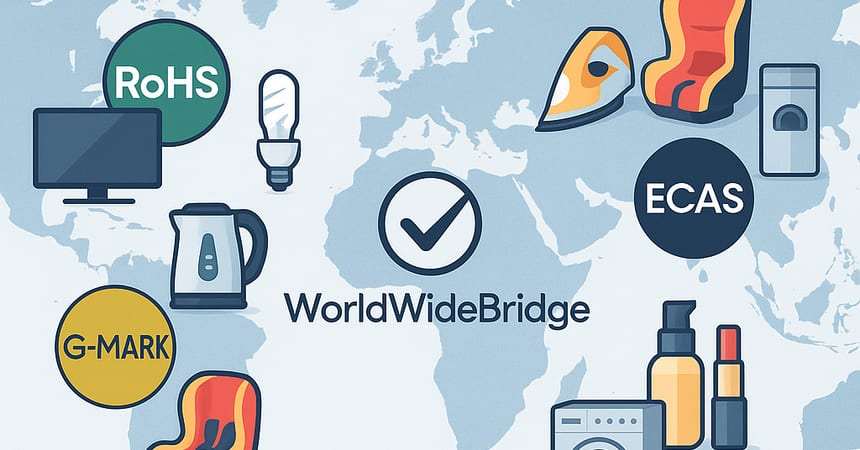
Which Products Need RoHS, G-Mark or ECAS
Three schemes covering the EU, the GCC and the UAE, with the product categories each captures, and when a high-risk product moves up to EQM.
A route assessment is a written statement, produced before any sample is shipped, of which legislation applies to a product in a target market, what document it will end up holding, what evidence that document needs, in what order the evidence has to be produced, and where the schedule risk sits. It is the cheapest stage of a certification project and it is the stage that sets the cost of every stage after it, because testing to the wrong standard, applying to a body without the right accreditation and discovering a local representative is mandatory are all decided here, on paper, and all expensive to reverse later.
Which legislation applies. Rarely one piece. A mains-powered device with a radio module is assessed under the radio legislation, which absorbs the safety and electromagnetic requirements; the same device without the radio is assessed under two separate directives with different evidence. Which of those a product is decides the test plan, and it is a question about the bill of materials rather than about the market.
What document you end up with. A certificate from a third party and a declaration you sign yourself are different projects with different costs, and the choice is usually not yours — it is set by the product’s category within the regulation. The most common misreading is to assume the cheaper route because the product feels low-risk.
What evidence is required, and from whom. Accreditation is per standard and per laboratory, not general. A report from an excellent laboratory that is not accredited for that standard, or is not recognised by the destination, is refused, and the samples are shipped again.
Whether someone has to be established locally. The European Union, the United Kingdom, the Eurasian Economic Union and Brazil each require a party established in the territory to be named in the documentation. This is a recurring annual cost rather than a one-off and it is the item most often absent from a first estimate.
Where a product is going to several markets, the order in which the evidence is produced decides whether one test campaign supports all of them or whether each market pays for its own. Markets that reference the same underlying standards can often be served by a single campaign at a laboratory whose reports they all accept — but only if the campaign was specified that way at the start.
Retrofitting a second market onto testing already completed rarely achieves the same saving. The reports exist, they were scoped for one destination, and the gaps are exactly the clauses the second destination cares about. That is why the assessment covers every intended market at once even where only the first one is being funded.
The other sequencing trap is the factory audit. Schemes that require an audit of the manufacturing site — and several do — turn a project measured in weeks into one measured in months, and the audit cannot be compressed by paying more. It is visible at this stage and invisible later.
The output is a document, not a conversation: the applicable legislation named, the document type, the evidence list, the sequence, the schedule risks, and an itemised quotation against it. It is deliberately written to be forwarded internally, because the person who commissions it is usually not the person who has to defend the budget for it.
It also names what is not needed. A scope determination that removes a directive, or establishes that a product is outside a regulated category, is a common outcome and the most valuable one, because it removes a test campaign rather than planning one.
| Decision | Taken here | Cost of taking it later |
|---|---|---|
| Applicable legislation | From the bill of materials and the intended market | A test campaign against the wrong standard |
| Document type | Certificate, declaration, registration or permit | An application refused by the wrong body |
| Laboratory selection | Accreditation checked per standard and per destination | Samples shipped and tested a second time |
| Local representation | Established before the application, where required | A certificate that cannot be issued at the last step |
| Multi-market sequence | One campaign specified for every intended market | Per-market testing at full price |
| Factory audit exposure | Identified before any booking | Months added to a schedule already committed |
Every row in the right-hand column is money spent twice rather than money spent late. That is the whole argument for the stage: it is a small fraction of the project cost and it is what stops the large fractions being repeated.
Everything on the left is something to find before the project starts. Everything on the right is ours. Send what you have and we will tell you what is missing.
You provide
We provide
A written statement of which legislation applies, what document you will end up holding, what evidence is needed, in what order, and where the schedule risk sits, with an itemised quotation against it. It is produced before any testing is booked, because it is what stops a laboratory being booked against the wrong standard, and it is written to be forwarded to whoever has to approve the budget.
Normally two working days from receiving the product description and the target markets, and scoping costs nothing and commits you to nothing. What takes longer is a product whose bill of materials is not yet settled, because the applicable legislation follows the components rather than the intended use.
Usually a great deal. "CE marking" names a family of directives and regulations, not a single route, and which of them apply — and whether a notified body has to be involved at all — is set by the product’s category within each one. A product can carry CE marking under one directive on a self-declaration and under another only after a third party has reviewed the file.
That is the case where it pays for itself most clearly. Where markets reference the same underlying standards, one test campaign at an appropriately accredited laboratory can support several submissions, but the campaign has to be specified that way before the first booking. Adding a second market afterwards usually means testing the clauses the first campaign did not cover, at close to full price.
That is a normal outcome and the most valuable one, because it removes a test campaign instead of planning one. It is written down with the reasoning and the scope references behind it, so it can be shown to a customer or a customs broker who assumes otherwise.
Three schemes covering the EU, the GCC and the UAE, with the product categories each captures, and when a high-risk product moves up to EQM.
Six categories, from food and cosmetics to vehicles, baby products and medical devices, with the authority and the specific requirements for each.
Requirements misread, documents incomplete, budgets set too late, samples stuck in transit, the four failures that stall electrical certification.
One specialist owns your file from the first email to the registered certificate. Every one of them has recorded a briefing on their field.
Send the product name, HS code and technical data. You get back the applicable route, the document list and a timeline, before any commitment. The reply is the assessment in outline: the scheme, the standard edition and the evidence you can reuse.
Scoping is freeReply within one working day