Products Needing Mandatory UAE Certification in 2025

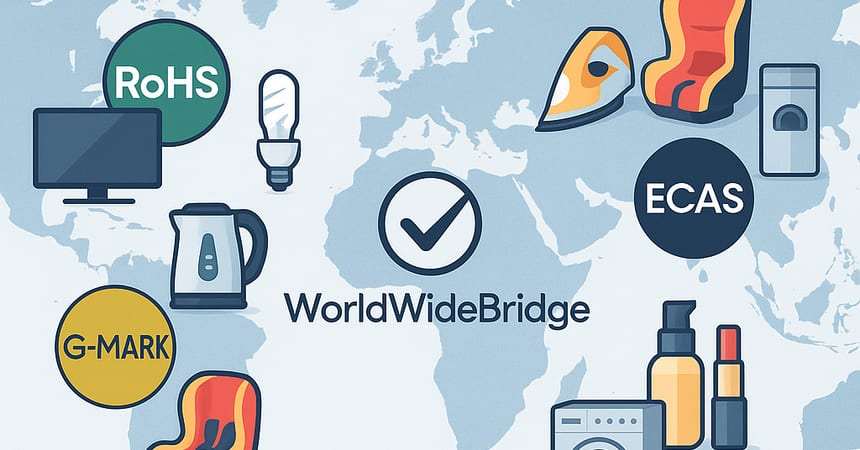
The UAE controls product quality and safety through mandatory certification across six broad categories. Each has its own authority and its own specific requirements, cosmetics register with MOHAP, electronics go through ECAS, and food needs Arabic labelling and halal for meat.
Food and beverages
All food products, imported included, must comply with ESMA standards:
- Halal certification for meat products
- Health and hygiene documentation
- Arabic labelling
- Nutritional information and expiry date, visible
Cosmetics and perfumes
Cosmetic and personal care products must be registered with MOHAP, the Ministry of Health and Prevention, and certified by ESMA:
- Ingredient documentation
- Product safety assessments
- Laboratory tests, where required
The distinguishing feature of this category is that two authorities are involved.
Electronics and household appliances
Certification through ECAS, the Emirates Conformity Assessment Scheme, covering:
- Mobile phones and laptops
- Refrigerators, air conditioning units, washing machines
- Lighting systems
- Chargers and adapters
Automobiles and auto parts
- Safety testing
- Emission control verification
Baby products
Toys, baby clothing, car seats, baby food and furniture. Certification confirms:
- Compliance with toy safety standards such as ISO 8124
- Absence of toxic substances
- Physical safety and durability
The breadth of this category is what catches sellers out, baby food and a cot are assessed under the same umbrella as a toy, against different technical standards.
Medical devices
From diagnostic tools to surgical equipment, devices must be certified and registered with MOHAP:
- Proof of clinical effectiveness
- ISO or CE certifications
- Product listing on the MOHAP system
Two schemes sit behind all six categories
Before the category detail, the structural point that decides most projects:
| ECAS | EQM | |
|---|---|---|
| Full name | Emirates Conformity Assessment Scheme | Emirates Quality Mark |
| Purpose | Market access | Quality mark on the product |
| Status | Mandatory for regulated products | Voluntary, except where it is not |
| Validity | One year | Three years |
Both apply to imported and locally manufactured goods alike. The exception: EQM is mandatory for bottled and mineral water, most juices and beverages, and certain dairy products. For a drinks importer it is the requirement rather than the optional badge.
Is the authority still called ESMA?
ESMA, the Emirates Authority for Standardization and Metrology, was folded into the Ministry of Industry and Advanced Technology (MOIAT) in 2020. The schemes kept their names; the issuing body changed. Anything published before the merger, including a good deal of guidance still circulating, names ESMA as the authority.
What does an application need?
- A valid UAE importer trade licence and a MOIAT system account, the application is filed from inside the country, not from the factory
- Accredited test reports, with CB reports and certificates generally accepted where they are recent and cover the UAE deviations
- Technical documentation, label artwork for validation, and for formulated products the ingredient or material review
- Confirmation that what reaches the shelf matches the evidence approved
Plan on four to eight weeks from a complete submission to an issued ECAS certificate. Incomplete submissions do not queue, they return.
Two adjacent cases sit alongside this one: selling on Noon or Amazon.ae without certification, and food product certification in the UAE.
What does non-compliance cost?
Fines, product recalls, or sales bans. Understanding the requirements, working with accredited certification bodies, and submitting proper documentation are what prevent all three, and all three are decided before the goods ship.
Sources
- MOIAT, Ministry of Industry and Advanced Technology, ECAS and EQM schemes (ESMA merged into MOIAT in 2020)
- MOHAP, Ministry of Health and Prevention, United Arab Emirates
- ISO 8124 series, Safety of toys
Frequently asked questions
What do food products need?
Compliance with ESMA standards, including imported goods: halal certification for meat products, health and hygiene documentation, Arabic labelling, and visible nutritional information and expiry dates.
Which authority handles cosmetics?
Cosmetic and personal care products must be registered with the Ministry of Health and Prevention (MOHAP) and certified by ESMA. Registration means ingredient documentation, product safety assessments, and laboratory tests where required.
Is the authority still called ESMA?
No. ESMA, the Emirates Authority for Standardization and Metrology, was merged into the Ministry of Industry and Advanced Technology (MOIAT) in 2020. The schemes kept their names, so ECAS and EQM certificates are still ECAS and EQM, but they are issued under MOIAT. Paperwork and guidance written before the merger still says ESMA.
How long does an ECAS certificate last?
One year, renewed annually. The Emirates Quality Mark runs three years. For a complete submission with valid accredited test reports, MOIAT typically issues an ECAS certificate in four to eight weeks, which is the number to plan a launch around, not the testing time.
What applies to baby products?
Toys, baby clothing, car seats, baby food and furniture all fall in this category. Certification confirms compliance with toy safety standards such as ISO 8124, the absence of toxic substances, and physical safety and durability.
Not sure which of these applies to your product? Send it and we will tell you
Related articles
Which Products Need RoHS, G-Mark or ECAS
Three schemes covering the EU, the GCC and the UAE, with the product categories each captures, and when a high-risk product moves up to EQM.
Selling Uncertified Products on Noon or Amazon.ae
Opening a store is easy; UAE product compliance law still applies. Which categories need certification, what happens without it, and the limited exceptions.
Certifying Products for UAE and Saudi Marketplaces
ESMA, SASO IECEE, SABER, halal and G-Mark, which applies, the seven-step process, and the Arabic labelling marketplaces check before listing.