Cosmetics Certification for the UAE and Saudi Arabia
ECAS certificates and Dubai Municipality Montaji registration in a week, GHAD registration and an SFDA shipment certificate in a month, with no samples.

The UAE’s baseline certificate for electrical goods, cosmetics, chemicals and packaged food, issued by MOIAT per product. What it rests on and its timeline.
ECAS is the Emirates Conformity Assessment Scheme, run by MOIAT, and it is the certificate most products need to be placed on the UAE market. It is issued per product and rests on test reports to the relevant GSO or IEC standards, so a product with fitting reports from an ISO/IEC 17025 laboratory can be certified without shipping samples. The NAS case under this tag obtained ECAS LVE for electrical safety and ECAS RoHS for restricted substances that way. Above ECAS sits the Emirates Quality Mark, reserved for high-risk categories and adding a factory audit.
The scheme reaches further than electronics. Cosmetics, detergents and chemicals, packaged food and children’s products all have ECAS categories, and for cosmetics the certificate comes alongside Dubai Municipality registration. The Gulf cosmetics case under this tag obtained ECAS certificates in about a week on existing reports. Where applications fail is documentation, and a rejected application is re-filed from the start, so the file is checked against the category’s requirements before submission.
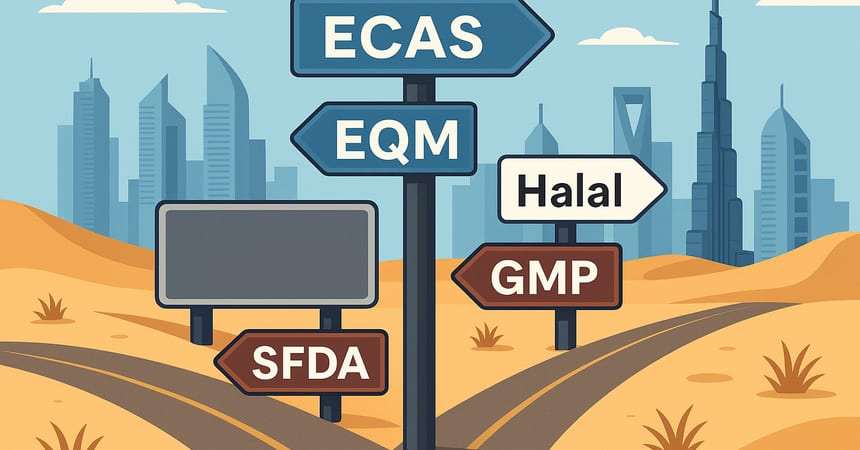
Three to eight weeks is the range where CB scheme or other accredited reports already exist; longer with EQM. The articles below cover the choice between ECAS, EQM, halal, GMP and SFDA, the product categories, marketplaces, food and the NAS and cosmetics cases. Send the product and your existing reports and we will say whether ECAS can issue on them.
No articles match that.
ECAS certificates and Dubai Municipality Montaji registration in a week, GHAD registration and an SFDA shipment certificate in a month, with no samples.
Three schemes covering the EU, the GCC and the UAE, with the product categories each captures, and when a high-risk product moves up to EQM.
Opening a store is easy; UAE product compliance law still applies. Which categories need certification, what happens without it, and the limited exceptions.
ECAS, EQM, Emirates Halal, GMP and SFDA do different jobs. Five questions that identify which your product needs, and where money gets wasted.
Three mandatory approvals for a network storage device, obtained in under five weeks with no hardware submitted. The documents, timings and fees.
Six categories, from food and cosmetics to vehicles, baby products and medical devices, with the authority and the specific requirements for each.
ECAS and EQM for sensitive categories like baby food, the documentation and testing that gets applications rejected, and the MOIAT platform in between.
Not in most cases. ECAS rests on test reports, and where an ISO/IEC 17025 laboratory has already tested the product to the standards MOIAT applies, the certificate issues on the reports. Samples come in when the reports are missing, outdated or cover a different revision of the product.
One year, renewed on the same file if nothing about the product has changed. Renewal is the point at which an outdated test report gets noticed, so keep the reports matching the product as currently built.
Send the product name, HS code and technical data. You get back the applicable route, the document list and a timeline, before any commitment.
Scoping is freeReply within one working day