
Cosmetics Certification for the UAE and Saudi Arabia
ECAS certificates and Dubai Municipality Montaji registration in a week, GHAD registration and an SFDA shipment certificate in a month, with no samples.
How a whitening, sun-protection or children's claim changes the approval route, and why the authorisation is held locally.
Reviewed
In cosmetics the wording on the pack is a regulatory decision. Under TR CU 009 an ordinary cream, shampoo or tonic with no pharmaceutical effect takes a declaration of conformity, valid for one, three or five years, and one declaration is issued per declared product type. Add a claim and the route changes. Skin lightening and whitening, artificial tanning, depilation, peeling, hair dye, oral hygiene, protection of the skin from harmful factors, and anything positioned for children all need a State Registration Certificate, which has unlimited validity and must name every plant that can make the product.
The same logic runs outside the Eurasian Economic Union. ANVISA regulates cosmetics in Brazil against Brazilian ingredient rules, prohibiting some substances outright and capping the concentration of others, preservatives and colorants in particular, so an EU-compliant formulation still has to be rechecked. The agency wants toxicological, microbiological and stability results, a documented production process against ISO 22716, and Portuguese labelling. In the UAE, Dubai Municipality registration turns on an INCI ingredient list and the absence of banned substances such as hydroquinone or lead.
What almost never travels is the right to hold the approval. A foreign manufacturer cannot be the applicant for a TR CU 009 declaration or a State Registration Certificate; the applicant has to be a legal resident of the union, and the authorised representative inside it is a mandatory label field. ANVISA and INMETRO both require a Brazilian legal representative. Saudi GHAD registration runs through a local representative before a CPNR number is assigned, and a Dubai Montaji registration belongs to the entity that filed it.
Two things decide how long a cosmetics project actually takes. The first is the composition in percentage, because the number of different formulations drives the number of test reports, and the safety indicators that apply follow from what is in the product. The second is artwork. The fifteen mandatory EAC label items have to be on the pack before import, since relabelling on arrival is not a route, so labelling sits on the critical path rather than at the end of it.
No articles match that.
ECAS certificates and Dubai Municipality Montaji registration in a week, GHAD registration and an SFDA shipment certificate in a month, with no samples.
INMETRO handles equipment and machinery, ANVISA handles cosmetics and health products. Different stages, different validity, and one shared prerequisite.
Dubai Municipality registration, a trade licence, physical stock in country and ongoing compliance, the four things a listing requires before the first sale.
What ANVISA requires before a cosmetic can be sold in Brazil: the four document sets, the three tests, Portuguese labelling rules and the ingredient limits.
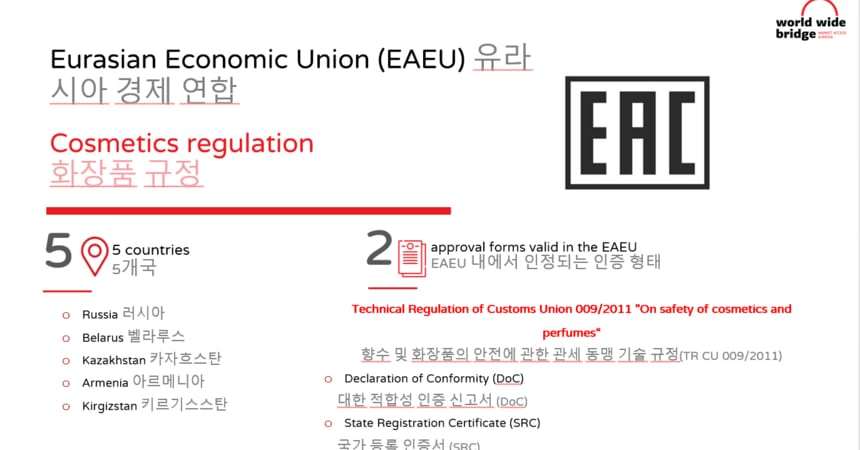
The ten-part agenda of a WWBridge webinar on entering the EAEU cosmetics market, approval forms, ingredient lists, and the safety indicators assessed.
A declaration per product type under TR CU 009, plus state registration for listed categories. Why compositions in percentage decide the test report count.
The fifteen items a cosmetics label must carry in the Customs Union, including the two that only apply to specific product types.
Yes, and it is the most common reason a project changes shape halfway through. A declaration under TR CU 009 covers ordinary cosmetics, but products for skin lightening and whitening, artificial tanning, tattoo application, intimate hygiene, depilation and peeling, hair dyes, oral hygiene products, cosmetics that protect the skin from harmful factors and cosmetics for children require a State Registration Certificate. One certificate covers one product type with one composition and effects, and it must list every production facility.
Not in any of the markets covered here. The TR CU 009 declaration and the State Registration Certificate must be applied for by a legal resident of the Eurasian Economic Union. ANVISA and INMETRO both require an authorised representative established in Brazil, with the file in Portuguese. Saudi GHAD registration needs a local representative, and UAE registration needs a company holding a trade licence for cosmetics. Fix the holder before filing, because registrations are tied to the entity that made them and moving them later is expensive.
Send the product name, HS code and technical data. You get back the applicable route, the document list and a timeline, before any commitment.
Scoping is freeReply within one working day