ANVISA Cosmetic Certification in Brazil: A Route Map

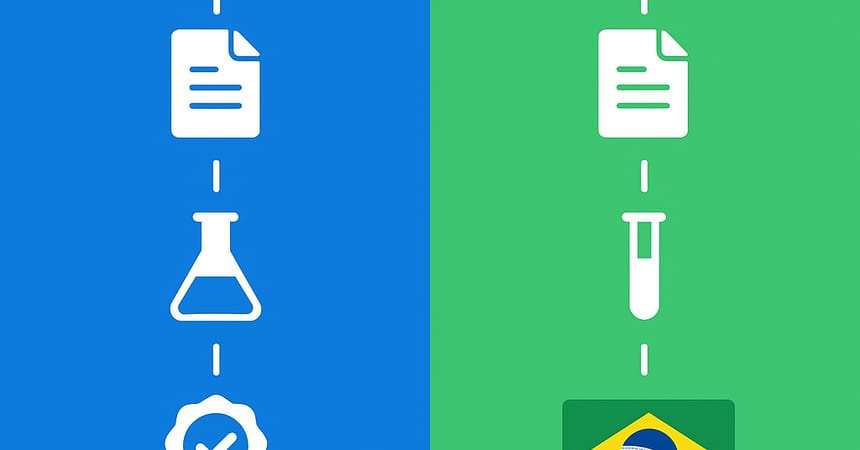
Cosmetics sold in Brazil are regulated by ANVISA, the Brazilian Health Regulatory Agency. Certification runs in six stages: assemble four document sets, complete toxicological, microbiological and stability testing, bring labelling into Portuguese, submit, answer ANVISA's questions, and receive the certificate. Formulations must also clear Brazil's own ingredient rules.
Who regulates cosmetics in Brazil?
ANVISA, the Brazilian Health Regulatory Agency. It sets the rules governing the safety, quality and efficacy of every cosmetic product on the Brazilian market, and it is the body that issues the certification allowing a product to be sold there legally.
Brazil is the largest economy in Latin America, with a strong personal-care culture and distribution running through traditional retail, e-commerce and direct sales. The market is attractive; the regulatory route into it is specific, and it is not the European one.
What documents does ANVISA want?
Four sets, assembled before anything else happens:
| Document set | What it has to show |
|---|---|
| Product composition | Every ingredient, with concentration and specification |
| Production process | Raw materials, mixing and processing methods, GMP adherence |
| Technical specifications | Physical and chemical properties, stability, other characteristics |
| Safety documentation | Toxicological and microbiological results, supporting research |
Completeness matters more than volume here. Gaps are the most common reason a file comes back with a request for additional information, and every round trip adds to the timeline.
What testing is required?
Three kinds, all run by laboratories working to ANVISA’s guidelines:
- Toxicological, skin irritation, sensitivity, potential toxicity, and the other parameters that establish the product is safe in normal use.
- Microbiological, confirming no microbial contamination: bacteria, fungi, yeasts.
- Stability, confirming the product holds its physical, chemical and microbiological properties under different storage conditions.
What is different about Brazilian requirements?
Two things trip up manufacturers arriving from another regulated market.
Ingredient restrictions. ANVISA prohibits certain ingredients outright on safety grounds, and caps the concentration of others, preservatives and colorants in particular. A formulation has to be checked against the Brazilian list specifically; clearance elsewhere does not carry over.
Good Manufacturing Practices. ANVISA places real weight on GMP, covering facilities, equipment, personnel, processes and quality control. Demonstrable GMP compliance is part of how the agency reads an application.
What does the process look like end to end?
- Documentation, assemble the four sets above.
- Testing, toxicological, microbiological, stability.
- Labelling and packaging, Portuguese, with product name, ingredients, warnings, usage instructions and batch number.
- Submission, application plus the complete file.
- Review, ANVISA assesses compliance and may come back with questions.
- Issuance, certification confirming the product may be sold in Brazil.
How long does it take?
There is no single answer, and anyone offering one is guessing. The timeline moves with the complexity of the product, how complete the documentation is on first submission, and ANVISA’s own review queue. The variable you control is the second one, so put the extra time into the documentation stage.
Frequently asked questions
Does an EU cosmetic dossier satisfy ANVISA?
Not on its own. ANVISA sets its own requirements, and the ones that most often catch European manufacturers are the ingredient rules and the labelling. Brazil prohibits certain substances outright and caps the concentration of others, such as preservatives and colorants, so a formulation that is compliant in the EU still has to be checked against the Brazilian list.
Which tests does ANVISA certification require?
Three. Toxicological testing covers skin irritation, sensitivity and potential toxicity. Microbiological testing confirms the absence of bacteria, fungi and yeasts. Stability testing confirms the product holds its physical, chemical and microbiological properties across different storage conditions.
Do labels have to be in Portuguese?
Yes. Labelling and packaging must comply with ANVISA's requirements in Portuguese, and must carry the product name, the ingredient list, warnings, usage instructions and the batch number.
Not sure which of these applies to your product? Send it and we will tell you
Related articles
INMETRO and ANVISA: Two Brazilian Routes Compared
INMETRO handles equipment and machinery, ANVISA handles cosmetics and health products. Different stages, different validity, and one shared prerequisite.
Cosmetics Labelling Requirements for the EAC Mark
The fifteen items a cosmetics label must carry in the Customs Union, including the two that only apply to specific product types.
Exporting Food and Cosmetics to China: Four Steps
Check the HS code, register the trademark, get a Cypher ID under GACC Decrees 248 and 249, and produce the Chinese counter-label. In that order.