Halal, Kosher and National Standards in the GCC
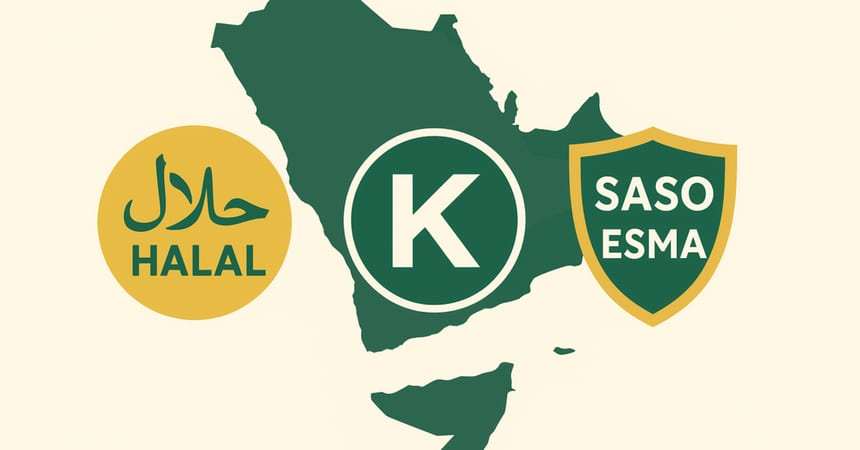
Halal opens the market and national certification makes the product legal. Neither substitutes for the other, and customs checks both.
The Gulf conformity mark, the G-Mark, shows that a product meets a technical regulation of the GCC Standardization Organization (GSO) and may be placed on the market in all GSO member states: the United Arab Emirates, Saudi Arabia, Kuwait, Qatar, Bahrain, Oman and Yemen. Two product regulations carry it: <strong>BD-142004-01</strong> on low-voltage electrical equipment and appliances, and <strong>BD-131704-01</strong> on children's toys. Products on the regulated list need a Gulf Type Examination certificate from a GSO-notified body and the Gulf Conformity Tracking Symbol; other low-voltage products are self-declared by the manufacturer and registered with GSO. The mark is regional and does not replace UAE ECAS or Saudi SABER.
Two groups. The first is low-voltage electrical equipment under BD-142004-01, meaning anything designed for 50 to 1,000 V AC or 75 to 1,500 V DC, in force since 1 July 2016. Inside that scope sits a shorter regulated-products list of household appliances, including air conditioners, refrigerators and freezers, washing machines, dishwashers, microwave ovens, kettles, irons, fans, food processors and hair dryers. The second group is toys under BD-131704-01: any product designed or intended for play by children under 14, in force since 1 January 2014.
A product outside both regulations does not carry the mark. Industrial machinery, medical devices, vehicles and cosmetics all have Gulf or national rules of their own, and applying for a G-Mark on one of them produces a document no customs officer will ask for.
The standards behind the mark are GSO adoptions of IEC and EN texts: the GSO IEC 60335 series for appliances, and the GSO EN 71 series plus GSO IEC 62115 for toys. A CB scheme report to the IEC edition is the usual starting point, and the notified body checks it against the GSO edition and the Gulf plug and voltage deviations.
It depends on the list. For products on the regulated list of BD-142004-01, and for every toy in scope, a body notified by GSO examines the technical file and test reports and issues a Gulf Type Examination certificate. You then draw up the Gulf Declaration of Conformity, and the product carries the G-Mark together with the Gulf Conformity Tracking Symbol (GCTS), a coded label that GSO's tracking system links to the certificate and that inspectors can check against it.
For low-voltage products outside that list the route is self-declaration: you assemble the technical file, keep production under control, register the product and the mark with GSO, and sign the declaration yourself. The mark then shows your registration number, and no body examines the type before sale. Market surveillance can still ask for the file, so the reports have to exist before the first shipment.
The type examination certificate covers the type as examined. A new supplier for the power board, a different plug or a changed rating plate is a change to the type, and the notified body has to assess it before the certificate still applies. The body may also visit the factory for higher-risk categories.
No. The Gulf has a shared layer and national layers on top. The G-Mark is the shared layer for its two regulations. The UAE adds the ECAS certificate from MoIAT, per product and per applicant. Saudi Arabia adds SABER: a product certificate of conformity (PCoC) from a SASO-approved body, then a shipment certificate (SCoC) for each consignment. Halal, where a product needs it, is recognised state by state.
A regional launch therefore starts from a per-country matrix. The G-Mark removes one type examination and one set of tests from each national file, and that saving is real, but the national registrations remain and each is tied to a local importer.
How the mark is used at each border, and which national registration sits beside it, is on the country pages: United Arab Emirates, Saudi Arabia, Kuwait, Qatar, Bahrain and Oman.
| Scheme | Issued by | Basis | Relationship to G-Mark |
|---|---|---|---|
| G-Mark | GSO-notified body, or self-declared and registered with GSO | Per type, under BD-142004-01 or BD-131704-01 | The regional layer for low-voltage equipment and toys |
| ECAS | MoIAT (United Arab Emirates) | Per product, one year | Additional; not replaced by G-Mark |
| SABER PCoC and SCoC | SASO-approved body (Saudi Arabia) | Per product, then per shipment | Separate registration and certificates |
| Halal | Body recognised by each state | Per product | Separate, with per-state recognition |
Everything on the left is something to find before the project starts. Everything on the right is ours. Send what you have and we will tell you what is missing.
You provide
We provide
For products under BD-142004-01 or BD-131704-01, one Gulf Type Examination certificate or one registered declaration is valid in all seven GSO member states. It does not remove the national schemes: the UAE still requires an ECAS certificate, Saudi Arabia still requires SABER, and halal is recognised per state.
Low-voltage electrical equipment rated 50 to 1,000 V AC or 75 to 1,500 V DC, and toys for children under 14. Within the low-voltage scope, household appliances on the regulated list need a notified body and the tracking symbol; the rest are self-declared. Products under neither regulation should not carry the mark.
No. The G-Mark is regional, issued per type under a GSO technical regulation, and is not tied to an importer. ECAS is the UAE national certificate from MoIAT, issued per product to a named applicant for one year. A kettle sold in Dubai needs both, and the same test reports serve both files.
Four to ten weeks where test reports to the GSO or IEC standards already exist. Regulated-list appliances and toys add the notified body's type examination and the tracking symbol; a factory visit adds scheduling time. The G-Mark certificate cost follows the same split: self-declared products pay for tests and registration, regulated-list appliances add the type examination. Running the G-Mark, ECAS and SABER files in parallel keeps a regional launch inside a quarter.
Halal opens the market and national certification makes the product legal. Neither substitutes for the other, and customs checks both.
MOIAT, SABER, G-Mark and ESMA are separate schemes with one shared goal. Which products need approval, what the labs test, and what goes in the technical file.
ESMA, SASO IECEE, SABER, halal and G-Mark, which applies, the seven-step process, and the Arabic labelling marketplaces check before listing.
One specialist owns your file from the first email to the registered certificate. Every one of them has recorded a briefing on their field.
Send the product name, HS code and technical data. You get back the applicable route, the document list and a timeline, before any commitment.
Scoping is freeReply within one working day