






Halal, Kosher and National Standards in the GCC
Halal opens the market and national certification makes the product legal. Neither substitutes for the other, and customs checks both.
The first reply names the regulated-list category your product falls in, the plug and voltage variant Bahrain inspects, and the notified body we would file with.
In Bahrain the Gulf file is the whole file. What the regulation adds sits with the importer, and it comes with deadlines.
Source: GSO, Gulf Conformity Mark and Conformity Tracking System
Typical timeline4 to 10 weeks
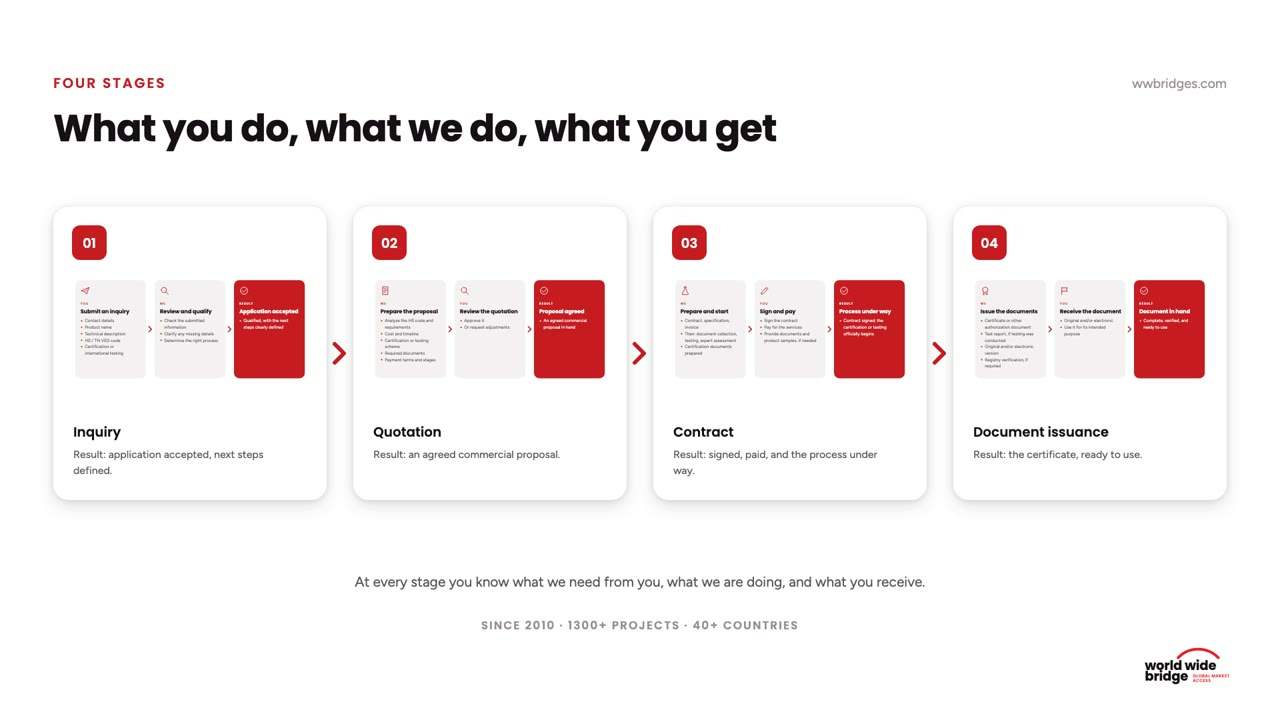

Product name, HS code and technical data, enough for us to scope the route.
Your part
A specialist confirms the regulations that apply and the document type your product needs.
Our part
You send the supporting documents; we sign a contract with fixed scope and timeline.
Both sides
Laboratory testing, factory inspection and customs clearance, coordinated by us.
Our partIssued, registered, and delivered. We close the project.
Your partIn Bahrain the G-Mark is the whole product-safety file for low-voltage equipment and toys. The Kingdom applies the GSO regulations BD-142004-01 and BD-131704-01 as written, with the Standards and Metrology Directorate (BSMD) of the Ministry of Industry and Commerce as its national body and no certificate of its own layered on top, unlike ECAS in the UAE or SABER in Saudi Arabia. A G-Mark Bahrain file is the Gulf Type Examination certificate from a GSO-notified body for the thirteen regulated-list categories, the Gulf Conformity Tracking Symbol on the product, the manufacturer and importer declarations in Arabic and English, and Arabic safety information. Plan four to ten weeks, as on the GCC G-Mark page.
Bahrain adds no certificate of the ECAS or SABER kind. The importer signs a declaration per consignment, puts its name and address on the product or packaging, and keeps the file ten years.
Drop the budget line for a Bahraini certificate and brief the Manama distributor instead.
TC-225310-01 lists Bahrain at 230/400 V and 50 Hz with plug type G, and type C only on Class II appliances. Saudi Arabia runs at 60 Hz, and the UAE allows type M.
A variant built for a Riyadh or Dubai order is a different type in Manama.
The certificate carries a colour image, the dimensions and the identification data of the type examined. A rating plate with another model code or rated input counts as another product.
Compare the plate on the shipping unit with the certificate image before loading.
Bahrain has no national certificate of its own, yet budgets still carry a line for one and none for the importer's declaration the regulation does require. Extension cords and USB chargers get self-declared because they are small, though both sit on List No. 2. A rating plate with a different model code from the certificate stops the product too. And a test report to an edition replaced over two years ago may need a delta.
Nothing national has to be carried over in Bahrain, because the Gulf file is the whole file. The importer signs its declaration per consignment and keeps both declarations for ten years. The certificate fixes the approved type through its colour image, dimensions and identification data, and a changed plug or cord set needs the notified body's assessment before the certificate covers the product again.
What we handle
Everything here is something to find before the project starts. The first reply says which of it can go into the file as it is.
One specialist owns your file from the first email to the registered certificate. Every one of them has recorded a briefing on their field.
Each stage is a service of its own, with a page that says what it produces and what it needs from you.
The cheapest stage decides the cost of every stage after it. What a route assessment names, and the four decisions it locks down.
Read the pageAccreditation is per standard and per laboratory, never general. How to choose one the destination accepts, and test once for several markets.
Read the pageThe file is the certificate’s foundation and it is the manufacturer’s to produce. What it has to contain, and what cannot be written retrospectively.
Read the pageAudits turn a schedule from weeks into months and cannot be compressed. What auditors check, and how to be ready for the first visit.
Read the pageFour major markets refuse to certify a foreign manufacturer directly. What the appointment obliges, and why a distributor is the wrong holder.
Read the pageA correct certificate and a wrong label still stops at the border. What each market demands on the artwork, and when to check it.
Read the pageNo. Bahrain is the smallest of the six Gulf markets and is served through the GCC layer plus the importer's own obligations. The national standards body is the Standards and Metrology Directorate (BSMD) of the Ministry of Industry and Commerce, set up in 1988 under Legislative Decree No. 16 of 1985 and a founder member of GSO. What GSO publishes for Bahrain beyond the shared regulations is narrow: it designates conformity assessment bodies as Bahrain notified bodies alongside the Gulf ones, and it runs the energy efficiency rating label for air conditioners in Bahrain and Oman.
So the G-Mark does more of the work here than in Dubai or Riyadh. The UAE adds ECAS from MoIAT; Saudi Arabia adds SABER with a certificate per shipment. In Bahrain the regulation's own paperwork is the paperwork: the type examination certificate, the tracking symbol, the two declarations and the importer's name and address on the product or its packaging.
The mistake we see is a budget line for a Bahraini national certificate that does not exist, and no line for the importer's declaration that does. The importer signs an Importer Declaration of Conformity for every consignment, keeps both declarations for ten years, and has twenty working days to produce the file when the competent authority asks. If your distributor in Manama has never heard of that declaration, the G-Mark certification Bahrain will accept is only half assembled.
The documents the regulation makes the importer and distributor responsible for, because those are what an inspector checks. For the thirteen categories on List No. 2 (TC143307-01), among them fans, refrigerators, washing machines, food processors, toasters, hair dryers, heaters, microwave and other ovens, water heaters, irons, air conditioners, and plugs, socket outlets, adaptors, cord extension sets and chargers, that means a Gulf Type Examination certificate from a GSO-notified body and the Gulf Conformity Tracking Symbol (GCTS) on the product, generated by GSO's tracking system for that certificate.
Every low-voltage product, on the list or off it, also carries the G-Mark, a type number and a batch or serial number, the manufacturer's trademark, name and address, safety information and instructions in Arabic, and the importer's name and address. The Manufacturer Declaration of Conformity is drawn up in Arabic and English to the model in Annex 5. Toys under BD-131704-01 follow the same shape, and an importer who cannot show the manufacturer's evidence goes through Annex V, where a notified body certifies each consignment.
Two failures recur. A self-declaration on a regulated-list appliance: extension cords and USB chargers are on the list, and a supplier who self-declares them because they are "small" has no certificate to present. And a rating plate that does not match the type examined: the certificate carries a colour image, the dimensions and the identification data of the approved type, so a plate showing a different model code or a different rated input is a different product until the notified body says otherwise.
GSO amendment TC-225310-01 fixes the supply per member state: Bahrain is 230/400 V ±6 % at 50 Hz with plug type G, the British three-pin pattern. The table is not uniform across the Gulf. The UAE allows types G and M, Kuwait G, M and C, and Saudi Arabia lists 127/220 V and 230/400 V at 60 Hz. Type C is admitted only for Class II appliances.
A product examined for the Saudi 60 Hz variant, or fitted with a type M plug for a UAE order, is a different type from the one Bahrain will inspect. The plug itself is a regulated-list product, so a cord set swapped at the last minute is not a packaging change; it is a change to the type, and the notified body has to assess it before the certificate still covers the appliance.
The certificate is only as good as the body that issued it. GSO can restrict a notified body's scope, suspend it or withdraw the designation, and the current status of every body is on the published list. A certificate from a body whose GSO notification has lapsed is the failure that surfaces at clearance and never at application, because the certificate itself looks the same. Check the body on the GSO list before you pay, and again before you ship.
Standards editions move. GSO adopts the latest edition of an IEC or EN text, and the previous adopted edition stays usable for two years from the update; a test report older than that may need a delta. A product is also filed with one notified body only, and moving to another body changes the GCTS registration and the markings on the product and packaging.
Two clearances are not part of this file at all. Halal is recognised state by state and sits on the halal page. The energy efficiency label for air conditioners in Bahrain is a separate GSO registration, because BD-142004-01 deals with safety and EMC and leaves energy efficiency to national regulation. A G-Mark certificate Bahrain accepts for safety does not cover either. Where the CB report to the IEC edition already exists, we assemble the file, place the type examination with a body whose designation we have checked, and return the certificate and tracking symbol inside the four to ten weeks the scheme takes across the Gulf.
| Item | Bahrain | Where it is fixed |
|---|---|---|
| National standards body | Standards and Metrology Directorate (BSMD), Ministry of Industry and Commerce | GSO members list |
| Supply | 230/400 V ±6 %, 50 Hz | TC-225310-01, Annex 1 of BD-142004-01 |
| Plug and socket type | Type G; type C for Class II only | TC-225310-01 |
| Regulated-list appliances | Gulf Type Examination certificate and GCTS | List No. 2, TC143307-01 |
| Declarations | Manufacturer and importer, in Arabic and English | Article 17, BD-142004-01 |
| Air conditioner energy label | Separate GSO registration for Bahrain and Oman | GSO energy efficiency rating |
No. Bahrain applies GSO regulations BD-142004-01 and BD-131704-01 through the Standards and Metrology Directorate of the Ministry of Industry and Commerce and adds no national product certificate of the ECAS or SABER kind. What it does add is the importer's side of the regulation: a declaration per consignment in Arabic and English, the importer's name and address on the product, and the file kept for ten years.
GSO amendment TC-225310-01 lists Bahrain at 230/400 V ±6 % and 50 Hz with plug type G. Type C is admitted only on Class II appliances. Because plugs, adaptors, cord sets and chargers are themselves on the regulated list, the plug fitted at shipment must be the one in the type examination certificate, or the certificate does not cover the product.
Four to ten weeks, the same range as the GCC G-Mark page, where a CB or IEC test report already exists. Regulated-list appliances and toys add the notified body's type examination and the tracking symbol. The step that stretches it is a rating plate or plug that differs from the samples tested, because the body then assesses a changed type.
Neither. Halal is recognised state by state and is a separate file. BD-142004-01 covers safety and electromagnetic compatibility only, and the energy efficiency rating label for air conditioners in Bahrain and Oman is a separate GSO registration. A G-Mark certificate proves safety of the type; it says nothing about either of those clearances.
Halal opens the market and national certification makes the product legal. Neither substitutes for the other, and customs checks both.
GCC Technical Regulation BD-131704-01 covers toys for under-14s. The hazard analysis required before market entry, Arabic warnings, and the three-step route.
Three schemes covering the EU, the GCC and the UAE, with the product categories each captures, and when a high-risk product moves up to EQM.
Send the product name, HS code and technical data. You get back the applicable route, the document list and a timeline, before any commitment.