Electrical Safety and EMC Requirements in Israel
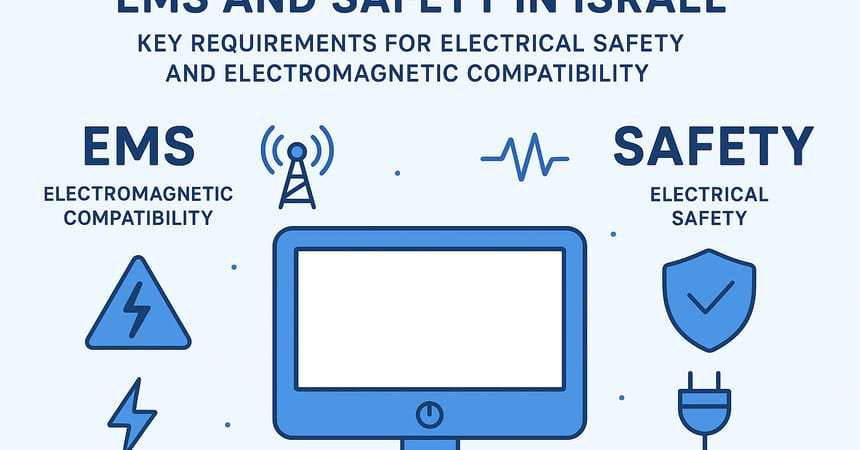
Israel's certification system covers Safety and EMC separately. Which IEC standard applies to which product class, and what each test programme covers.

Low-voltage safety in the EAEU, the EU, the Gulf, Israel and Canada, plus the CB Scheme. Which reports travel, where products fail, what to check first.
Electrical safety is the requirement every market shares and each one tests in its own way. In the EAEU it is TR CU 004/2011, a certificate for most consumer products and a declaration for much industrial equipment, with the operating manual in Russian as part of the file. In the EU it is the Low Voltage Directive behind the CE mark. In the Gulf ECAS, SABER and the G-Mark test it to IEC-based GSO standards. Israel approves on CB reports or exempts by customs code, with 62368 TI now replacing IEC 60950-1 and 60065 for electronics. Canada assesses a connected lock as an electrical product, a radio device, a fire-relevant assembly and a data-holding device at once.
The IECEE CB Scheme is what lets one safety test travel. A CB test certificate and report from one accredited laboratory are accepted by bodies in more than 130 countries and converted into national certificates without retesting, six weeks or so for testing and certification. It is the basis of SII approval in Israel and of most ECAS files, and the luminaire standards under it are a family, IEC 60598-2 with a separate part per luminaire type. Adapting a product to another country’s plugs, voltage and labelling is where most projects meet their first real cost, and a European product may not satisfy Middle East requirements.
Four problems account for most stalled projects: not knowing which requirements apply, incomplete documentation, budgets set before the testing scope is known, and samples that arrive late or in packaging that fails. The articles below cover each market, the CB Scheme, common problems and the IT and lighting standards. Send the product, its voltage and any CB report and we will say which markets that report already opens.
No articles match that.
Israel's certification system covers Safety and EMC separately. Which IEC standard applies to which product class, and what each test programme covers.
It replaced IEC 60065 and 60950-1 with one risk-based system. What Energy Source Classification changes, and which products it now covers.
Electrical safety, EMC, fire, cybersecurity and bilingual labelling all apply to a connected lock. The six-step route, and the provincial traps.
MOIAT, SABER, G-Mark and ESMA are separate schemes with one shared goal. Which products need approval, what the labs test, and what goes in the technical file.
Requirements misread, documents incomplete, budgets set too late, samples stuck in transit, the four failures that stall electrical certification.
Plug types, voltages and labelling differ by country, and a European product often fails Middle East requirements. What to check before redesigning.
ICASA, NRCS and SABS explained, which two are mandatory for a connected vending machine, which is voluntary, and what it is nevertheless worth.
The four documents a PC may need for the Union, TR CU 004 and 020, RoHS, telecom and the encryption notification, plus how the 1c, 3c and 4c schemes differ.
How the CB Scheme turns a single IEC safety test into national approvals across 130+ countries: what it covers, timelines, samples and where testing happens.
A CB test report to the current IEC standard is the closest thing to it. It converts to national certificates in more than 130 countries, supports SII approval in Israel and ECAS in the UAE, and shortens the EAEU file. What it does not replace is testing in a Union laboratory where a TR CU 004 certificate requires one.
Plug type, supply voltage and labelling differ, and the GSO standards add requirements on top of the IEC base. In most of these cases the product is sound and the variant is wrong. Check the destination’s plug, voltage and marking rules before redesigning anything, and before booking a laboratory.
Send the product name, HS code and technical data. You get back the applicable route, the document list and a timeline, before any commitment.
Scoping is freeReply within one working day