Household Appliance Certification in the Gulf Countries
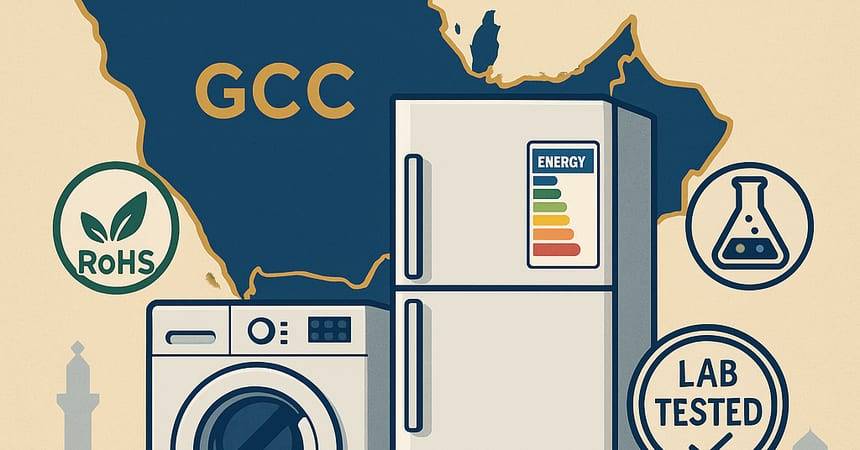
Selling appliances into the GCC means clearing five things at once: safety against IEC and ISO plus local requirements, mandatory energy efficiency labelling such as the SASO label in Saudi Arabia, RoHS and recycling obligations, testing in accredited GCC laboratories where required, and documentation in English and Arabic.
What does the GCC ask for on household appliances?
The household appliance market across the Gulf Cooperation Council is growing quickly. Entering it means satisfying five distinct requirements, and they are assessed separately.
1. Safety
All appliances must meet strict safety norms built on international standards, IEC and ISO, plus local requirements. In scope: electrical safety, overheating protection, fire safety, and mechanical durability.
2. Energy efficiency and labelling
GCC countries impose mandatory energy efficiency requirements. Saudi Arabia uses the SASO Energy Efficiency Label to tell consumers the energy consumption class of a product.
Certification includes testing and confirmation of energy performance. The label reflects a measured result, not a manufacturer’s claim, so it depends on test data being generated early enough to appear on packaging artwork.
3. Environmental requirements
Manufacturers must comply with RoHS and recycling regulations, reducing environmental impact in line with the region’s sustainable development policies.
4. Local testing
In some cases, testing in accredited GCC laboratories is mandatory. Establishing whether that applies to your product category is the first question to settle, because the answer determines whether existing international reports are usable or whether samples have to travel.
5. Documentation and labelling
All documentation, technical manuals, certificates, instructions, must be in English and/or Arabic. Product labelling must meet GCC standards: model, manufacturer, technical specifications and certification marks.
Which document do you apply for?
The five requirements above describe what is assessed. What you apply for is set by the destination, and the three routes are not interchangeable:
| Destination | Route | Shape of it |
|---|---|---|
| Saudi Arabia | SABER, under the SALEEM programme | A Product Certificate of Conformity per product, then a Shipment Certificate per consignment |
| United Arab Emirates | ECAS | One certificate per product, renewed annually |
| Across the GSO member states | G-Mark | Type examination by a notified body, then the mark on product or packaging |
A range sold across the region therefore carries more than one certificate, and the evidence behind them overlaps heavily, the same IEC 60335 safety report usually supports all three. What does not travel is the certificate itself.
The Saudi route has a feature worth planning for: the Product Certificate is issued in the name of your Saudi importer of record, so it does not follow the goods if you change distributor.
The Saudi platform and its two certificates are covered in certifying products for UAE and Saudi marketplaces; the toy-specific route is in G-Mark for children’s toys.
What tends to go wrong
The five requirements above are individually straightforward and collectively easy to sequence badly. Energy testing that finishes after the packaging is printed, or a safety report produced by a laboratory that turns out not to be accredited for the region, both mean repeating work rather than fixing it.
The order that works is: confirm which testing must be local, commission that testing first, then produce labelling and documentation against the results.
Sources
- SASO, Saudi Standards, Metrology and Quality Organization, Energy Efficiency Label requirements
- GSO, GCC Standardization Organization, technical regulations for electrical appliances
- IEC 60335 series, Household and similar electrical appliances, Safety
Frequently asked questions
Is energy labelling mandatory in the GCC?
Yes. GCC countries have mandatory energy efficiency requirements, and Saudi Arabia uses the SASO Energy Efficiency Label to show consumers the energy consumption class. Certification includes testing and confirmation of energy performance, so the label cannot be self-declared.
What language must the documentation be in?
English and/or Arabic, covering technical manuals, certificates and instructions. Product labelling must also meet GCC standards, which means model, manufacturer, technical specifications and certification marks all appear on the product itself.
Does testing have to happen in the region?
In some cases, yes, testing in accredited GCC laboratories is mandatory. Where it is not, existing international test reports may be usable, so establishing which applies to your product category is the first question to settle, before any samples are shipped.
Not sure which of these applies to your product? Send it and we will tell you
Related articles
Halal, Kosher and National Standards in the GCC
Halal opens the market and national certification makes the product legal. Neither substitutes for the other, and customs checks both.
Does Your Product Need an Energy Efficiency Label?
Which categories are regulated, the five inputs that decide the answer, and why the same specification can be exempt in one country and not the next.
Certifying Water Heaters, Lighting and Appliances
Which household products declare, which certify, when a fire safety certificate is added, and why an exemption letter is worth having at customs.