Halal Certification for Supplements in Morocco

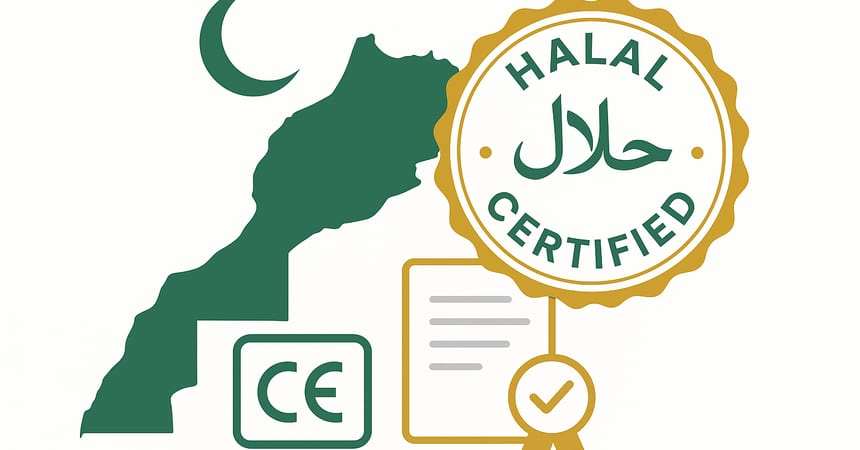
For dietary supplements and nutraceuticals in Morocco, a halal certificate is increasingly required, and even where it is not legally mandatory for the category, it decides whether pharmacy chains and major retailers will stock the product. Anything with gelatin, animal proteins or dairy components needs one.
Why it matters for supplements specifically
Morocco is a Muslim-majority country and consumers expect what is on the shelf to comply with Islamic norms. That expectation bites hardest on dietary supplements, nutraceuticals and food additives containing animal-derived ingredients, gelatin, capsules, milk proteins, bee products.
Even where a halal certificate is not legally mandatory for a specific category, it is critical for selling through major pharmacy chains and retailers, and it simplifies customs clearance.
The commercial case:
- Over 90% of Morocco’s population practises Islam
- Demand is growing for clean-label, ethical products
- Major retailers: Marjane, Carrefour, pharmacy chains, prioritise halal-certified goods
- Products without certification may be rejected during customs or sanitary checks, especially those with animal-derived ingredients
What is a halal certificate?
An official document confirming that a product contains no ingredients prohibited in Islam and was manufactured according to Sharia-compliant practices.
In Morocco, halal certificates can come from accredited domestic or international bodies. Recognised international authorities include:
| Body | Country |
|---|---|
| JAKIM | Malaysia |
| ESMA | UAE |
| IFANCA | USA |
| Halal Quality Control | Europe |
| IMANOR | Morocco, the national standards body, which may recognise some international certificates |
When is halal certification mandatory?
A halal certificate is mandatory where the product contains:
- Gelatin, especially in capsules
- Animal proteins, fats or extracts
- Lactose, dairy components or by-products
- Enzymes or flavours of non-plant origin
Capsules are the recurring problem. A plant-based formulation delivered in a bovine gelatin capsule is not a plant-based product for this purpose.
Even a fully plant-based product benefits from certification, because it raises trust and sales.
How long does halal certification take?
- Formula and process assessment.
- On-site or remote audit.
- Halal certificate issuance.
Typically three to six weeks, depending on document readiness and the country of production.
Documents needed
Product composition with the origin of each ingredient, which is the item that most often has to be obtained from suppliers rather than retrieved internally, and the reason “document readiness” swings the timeline so widely.
What certification provides
- Full access to the Moroccan market
- An advantage at customs clearance
- Higher trust from retailers and pharmacies
- The right to label products as halal
- A route to scale into MENA and West Africa, where halal is equally essential
Sources
- IMANOR, Institut Marocain de Normalisation
- JAKIM, ESMA, IFANCA, Halal Quality Control, internationally recognised halal certification bodies
- OIC/SMIIC halal standards series
Frequently asked questions
When is halal certification mandatory for a supplement?
Where the product contains gelatin, especially in capsules, animal proteins, fats or extracts, lactose, dairy components or by-products, or enzymes and flavours of non-plant origin. Even a fully plant-based product benefits, because certification raises consumer trust and sales.
Which certification bodies are recognised in Morocco?
Halal certificates can be issued by accredited domestic or international bodies. Recognised international authorities include JAKIM in Malaysia, ESMA in the UAE, IFANCA in the USA and Halal Quality Control in Europe. IMANOR, Morocco's national standards body, may recognise some international certificates.
How long does it take?
Typically three to six weeks, depending on how ready the documents are and on the country of production. The sequence is formula and process assessment, then an on-site or remote audit, then issuance.
Not sure which of these applies to your product? Send it and we will tell you
Related articles
Halal Certification in Morocco: What Exporters Face
Four sectors where halal now matters in Morocco, the requirements for food and for cosmetics and pharmaceuticals, and how IMANOR treats foreign certificates.
Registering Dietary Supplements in Morocco
Morocco has no separate supplement category, products register as food or as pharmaceuticals. That classification sets the route and the document package.
Six Mistakes Registering Supplements in Morocco
Ingredients legal in the EU but banned in Morocco, medical claims on labels, no local representative, and a four-month timeline people budget three weeks for.