Genuine vs Aftermarket Parts in the SABER System
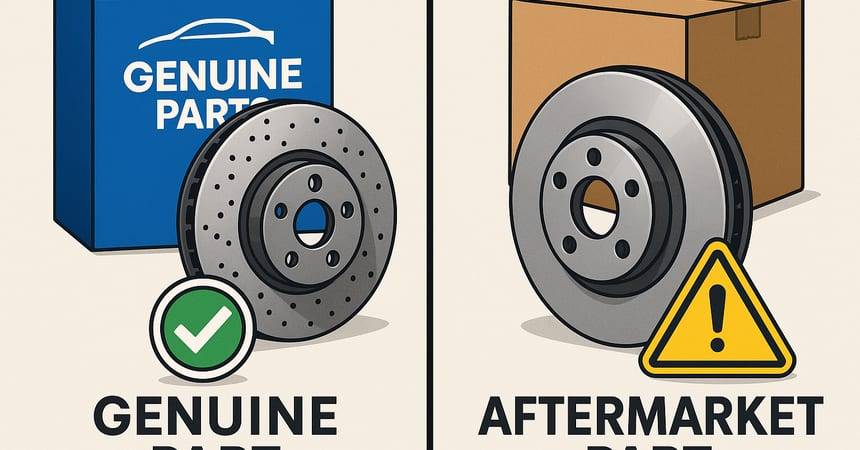
In the SABER system, genuine and aftermarket auto parts follow different certification paths. Genuine parts need confirmation of official origin and usually a declaration of conformity; aftermarket parts need full testing in accredited laboratories, with every product code registered.
Why does the classification come first?
Auto parts are among the most in-demand product categories in Saudi Arabia, and importing them means mandatory certification through the SABER system.
The key stage is correctly identifying whether the parts are Genuine or Aftermarket. A mistake here leads to import bans, fines and significant financial loss.
Genuine parts
Original parts manufactured by the automaker or its official contractors, used on vehicle production lines and distributed through authorised dealer networks.
- Manufactured under the automaker’s standards and supervision
- Supplied in branded packaging with official markings
- Identical to the parts fitted during original assembly
- Often accompanied by quality certificates and official warranties
In SABER these fall into a category permitting a simplified certification process, because they already comply with international standards and OEM requirements.
Aftermarket parts
Non-original components from third-party manufacturers who are not official suppliers to the automaker. They may be fully compatible with a vehicle without being officially recognised as original.
- Manufactured to independent designs and technology
- Often differ in materials, design or performance
- Marketed as cost-effective alternatives to OEM parts
- Not approved by automakers, and usually not covered by official warranties
In SABER these are subject to stricter controls, and often require additional laboratory testing and documentation.
How do the two certification paths differ?
| Genuine parts | Aftermarket parts | |
|---|---|---|
| Origin evidence | Confirmation of official origin, plus a certificate from the automaker or distributor | Not applicable |
| Testing | Usually none required | Full testing in accredited labs, strength, safety, local standards |
| Registration | Declaration of conformity usually sufficient | Each product code registered, with a complete document set |
Two further details decide whether the process runs or stalls: the correct HS code, and the appropriate technical regulation. A single error in either can delay a project by months.
What does a misclassification cost?
- SABER registration rejections
- Fines and import bans
- Delivery delays from repeated inspections
- Reputational risk for suppliers and distributors
There are two consequences beyond the immediate ones. Incorrect documentation can affect end-user rights, the validity of a vehicle warranty where non-OEM parts are fitted. And classification affects customs duties and taxes, since the categories can carry different rates and documentation requirements.
Sources
- SABER platform, Saudi Standards, Metrology and Quality Organization (SASO)
- SASO technical regulations for automotive spare parts
Frequently asked questions
What distinguishes genuine from aftermarket parts?
Genuine parts are made by the automaker or its official contractors, used on production lines and sold through authorised dealer networks, in branded packaging with official markings. Aftermarket parts come from third-party manufacturers who are not official suppliers, compatible, perhaps, but not officially recognised as original.
How do the certification paths differ?
Genuine parts typically need confirmation of official origin plus a certificate from the automaker or distributor, and in most cases a declaration of conformity is sufficient without additional laboratory testing. Aftermarket parts must undergo full testing in accredited laboratories, strength, safety and local standards, with each product code registered and a complete document set.
What happens if the classification is wrong?
SABER registration rejections, fines and import bans, delivery delays from repeated inspections, and reputational damage. Incorrect documentation can also affect end-user rights, such as vehicle warranty validity, and it changes the customs duties and taxes that apply.
Not sure which of these applies to your product? Send it and we will tell you
Related articles
Certifying Products for UAE and Saudi Marketplaces
ESMA, SASO IECEE, SABER, halal and G-Mark, which applies, the seven-step process, and the Arabic labelling marketplaces check before listing.
Electrical Equipment Compliance Across the Gulf and MENA
MOIAT, SABER, G-Mark and ESMA are separate schemes with one shared goal. Which products need approval, what the labs test, and what goes in the technical file.
RoHS Test Reports for Saudi Arabia and SABER
RoHS reports for Saudi Arabia must meet local requirements and feed the SABER platform. The four-step route from finding a laboratory to registration.