Certificates for Agricultural Suppliers to Israel
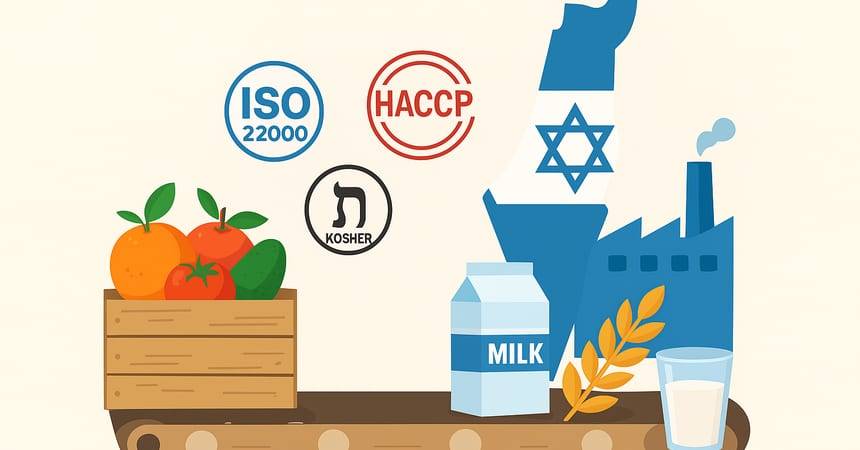
Israel leads on agricultural innovation and applies standards to match. Six certificate families cover suppliers, phytosanitary, agrochemical, veterinary, food quality, kosher and environmental, overseen by three authorities, with document preparation running from two to six months.
Who regulates agricultural imports into Israel?
Israel is a global leader in agricultural innovation, drip irrigation, smart farming, genetically resilient plant varieties, advanced storage. Its certification requirements are equally exacting, and three bodies oversee them.
| Authority | Responsibility |
|---|---|
| Ministry of Agriculture and Rural Development | Plant- and livestock-related products |
| Ministry of Health | Certification of food and beverages |
| Standards Institution of Israel (SII) | Technical standards mandatory for imports and production |
Which certificates do agricultural suppliers need?
1. Phytosanitary certificates. For importing seeds, seedlings, fresh fruit and vegetables, an international phytosanitary certificate issued in the country of origin is required. Israel monitors quarantine risks closely, and products undergo laboratory testing.
2. Pesticides and agrochemicals. Fertilisers, plant protection products and growth stimulants may only be imported with permits from the Ministry of Agriculture. Safety for humans and the environment is checked carefully.
3. Veterinary certificates. Meat and dairy suppliers need veterinary certificates confirming the absence of dangerous animal diseases.
4. Food quality. All food must comply with Ministry of Health standards. HACCP or ISO 22000 certification is often required, along with testing in Israeli laboratories.
5. Kosher certification. Most consumers in Israel follow kosher rules, so access to the mass market requires a kosher certificate from a recognised rabbinate.
6. Environmental standards. Israel is actively implementing requirements on packaging, waste disposal and sustainable production. Some categories need certificates confirming minimal environmental impact.
Practical advice for suppliers
- Start early. Document preparation takes from two to six months, and the phytosanitary and veterinary certificates depend on inspections in the country of origin that cannot be accelerated.
- Use international certificates as a foundation. ISO, HACCP and GlobalG.A.P. are useful groundwork, but expect local adaptation on top rather than automatic recognition.
- Treat kosher as unavoidable if you plan to work with major retail chains.
- Consider an Israeli distributor with experience of passing these inspections. The certificates are technical; the process of getting through them is local knowledge.
Sources
- Israeli Ministry of Agriculture and Rural Development, plant protection and veterinary services
- Israeli Ministry of Health, food import requirements
- SII, Standards Institution of Israel
- ISO 22000; Codex Alimentarius HACCP principles; GlobalG.A.P.
Frequently asked questions
Which certificates are mandatory for agricultural suppliers?
Phytosanitary certificates for seeds, seedlings and fresh produce; permits from the Ministry of Agriculture for pesticides and agrochemicals; veterinary certificates for meat and dairy; food quality certification against Ministry of Health standards, often HACCP or ISO 22000; kosher certification for the mass market; and environmental certificates for some categories.
Are international certificates accepted?
As a foundation. ISO, HACCP and GlobalG.A.P. certification is useful groundwork, but expect local adaptation: Israeli requirements are applied on top, and an international certificate does not waive them.
Not sure which of these applies to your product? Send it and we will tell you
Related articles
Certificates Required to Export to Morocco
Moroccan NM standards are largely harmonised with European ones, so ISO and CE do real work. Which certificates each sector needs, and four common mistakes.
Food and Beverage Certification in Israel
Three authorities, Hebrew labelling that is mandatory rather than customary, and kosher status that is not legally required but commercially decisive.
Halal, Kosher and National Standards in the GCC
Halal opens the market and national certification makes the product legal. Neither substitutes for the other, and customs checks both.