TR CU 032 vs the PED Directive: Two Philosophies
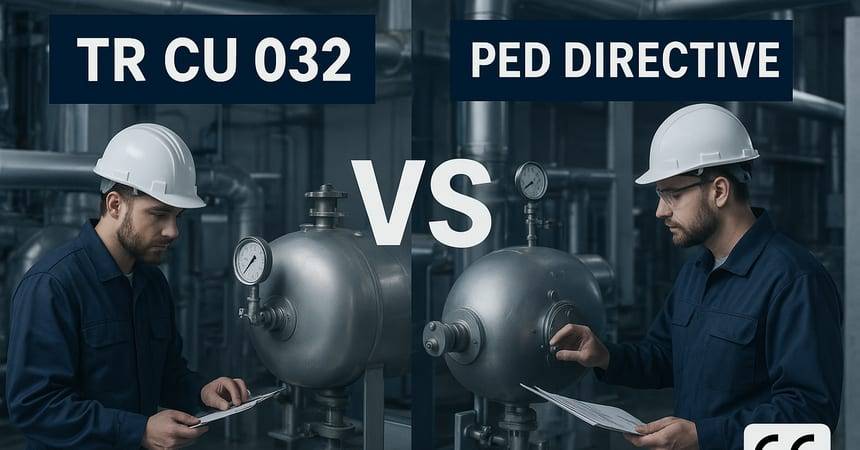
PED 2014/68/EU and TR CU 032/2013 chase the same outcome by different routes. PED is risk-oriented: the manufacturer proves safety through engineering argument and harmonised standards, choosing from modules A to H. TR CU 032 is normative: it sets the requirements, the test methods and the material criteria, and you meet them.
How do TR CU 032 and PED differ?
Both documents exist to protect people, equipment and the environment from accidents caused by pressure equipment. TR CU 032/2013 applies across the EAEU; PED 2014/68/EU, the Pressure Equipment Directive, applies within the European Union.
Where they part company is in who does the reasoning.
PED is risk-oriented. It builds a system in which the manufacturer carries maximum responsibility for risk analysis. In the EU the manufacturer must independently prove the equipment is safe, drawing on engineering principles, standards and multi-level assessment.
TR CU 032 is normative. It sets specific requirements, mandatory test methods, material selection criteria and technical parameters. That makes the process more predictable and less flexible than the European model.
Neither approach is a compromise on the other. They were developed for different economic and technological realities, and each is coherent on its own terms.
Side by side
| Aspect | TR CU 032/2013 | PED 2014/68/EU |
|---|---|---|
| Classification | Hazard categories from medium type, pressure and volume | Categories I, IV from detailed charts, formulas and criteria |
| Conformity route | Certification or declaration, fixed schemes | Modules A, B, C, D, E, F, G, H by risk level |
| Third parties | Accredited certification bodies and laboratories | Notified bodies, with a broader role |
| Emphasis | Design, materials and testing requirements | Risk analysis, manufacturer responsibility, harmonised standards |
| Marking | EAC | CE |
| Technical dossier | Meeting the regulation’s requirements; GOST or EN use permitted, not mandatory | Detailed risk analysis and comparison protocols against EN standards |
Where does PED go deeper?
PED regulates in considerably more detail:
- Welder qualification
- Non-destructive testing procedures
- Production requirements
- Quality system audits
TR CU 032 addresses all four, but less deeply, and frequently by reference out to GOST or other standards rather than by specifying inside the regulation itself.
What if you hold one and need the other?
A CE-marked pressure vessel arrives in an EAEU project with a technical file built around a risk argument. TR CU 032 will accept the underlying engineering, but it will ask different questions of it: which category does the medium and volume put this in, which fixed scheme follows, does the strength calculation exist to GOST, and is there a technical passport to GOST 34347-2017 in the Union’s working language.
None of those are answered by the PED file, however thorough it is. The work of moving between the systems is mostly translating evidence into a different form, and the engineering stays as it is.
Conversely, a manufacturer familiar only with TR CU meeting PED for the first time finds the opposite gap: the regulation tells them less than they expect, and the burden of demonstrating that a solution is adequate falls on them.
Sources
- TR CU 032/2013, On the safety of equipment operating under excessive pressure, Eurasian Economic Commission
- Directive 2014/68/EU on the harmonisation of the laws of the Member States relating to the making available on the market of pressure equipment
- GOST 34347-2017, Vessels and apparatus of steel welded. General specifications
Frequently asked questions
How do the classification systems differ?
TR CU 032 assigns hazard categories from the type of medium, the pressure and the volume. PED forms categories I to IV through more detailed charts, formulas and criteria. The inputs overlap, but PED's route to a category involves more computation and more judgement.
Which system is more flexible?
PED. Its conformity procedures span multiple modules: A, B, C, D, E, F, G, H, selected according to risk level, where TR CU uses certification or declaration with fixed schemes. That flexibility is also what makes PED less predictable to plan around.
Does one certification substitute for the other?
No. PED requires CE marking; TR CU 032 requires the EAC mark. The technical dossiers differ too: a PED file typically carries more detailed risk analysis and comparison protocols against EN standards, while a TR CU file concentrates on meeting the regulation's own requirements.
Not sure which of these applies to your product? Send it and we will tell you
Related articles
Strength Calculation: Why TR CU 032 Will Not Move Without It
The strength calculation is a named document in TR CU 032. Which GOST standards govern it, why a foreign calculation is not accepted, and the language rule.
EAC Certification of Heat Exchangers for the EAEU
Heat exchangers fall under TR CU 010 always, and under TR CU 032 sometimes. What each route requires, and why tube side and shell side are assessed separately.
TR CU 032: Certificate or Declaration for a Vessel
How TR CU 032/2013 sorts pressure vessels into categories 1 to 4, which category declares and which certifies, and the declaration and certification schemes.