Certifying Water Heaters, Lighting and Appliances
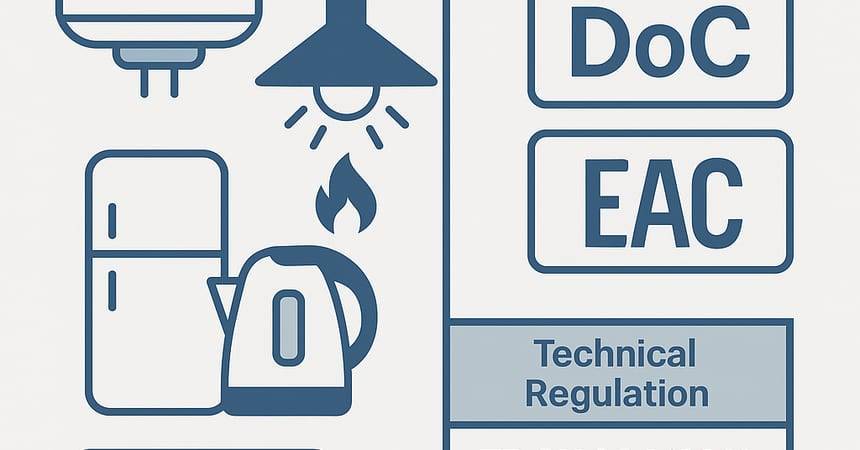
Small and medium appliances usually take a declaration; water heaters and complex lighting take a certificate, tested in an accredited laboratory. Some fixtures add a fire safety certificate under Federal Law No. 123, and a product outside the regulations still benefits from an exemption letter at customs.
Why the paperwork is not a formality
Certification is mandatory for importing and selling most electrical equipment and household appliances across the EAEU. What it buys:
- Product safety confirmed against local standards
- Smooth customs clearance and legal distribution
- Access to retail networks and major online marketplaces
- Consumer trust and reduced legal exposure
- The right to apply the EAC mark
Failure to comply leads to customs rejection, fines, seizure of goods, and, for repeat violations, criminal liability.
Which document applies?
| Document | Typically required for |
|---|---|
| Declaration of Conformity (DoC) | Small and medium household appliances, consumer electronics, LED fixtures, electric kettles, toasters |
| Certificate of Conformity (CoC) | Water heaters, high-voltage devices, built-in or outdoor lighting with complex systems |
| Fire safety certificate | Built-in ceiling lights, emergency lighting, fixtures for public infrastructure |
| Exemption letter | Products outside the mandatory technical regulations |
The declaration is the most common document and confirms the product meets the requirements of the relevant EAEU regulations.
The certificate is issued by a certification body after testing in an accredited laboratory, and is required where the product carries higher safety risk.
The fire safety certificate applies chiefly to lighting used in public, industrial or high-risk areas, and confirms compliance with Federal Law No. 123 on fire safety.
The exemption letter is an official explanation of why no mandatory regulation applies. Customs asks for something, and “nothing applies” is not a document.
What must appear on the product?
- The EAC conformity mark
- Rated voltage, frequency and power consumption
- Safety warnings and operating instructions in the Union’s working language
What happens after approval?
Customs and market surveillance authorities run random audits. Test reports, declarations and production documentation must be accurate and ready to hand; an archive that takes a fortnight to answer does not count as available.
That is the practical difference between having complied and being able to demonstrate compliance, and it is where otherwise well-run importers get caught.
Sources
- TR CU 004/2011, TR CU 020/2011 and TR EAEU 037/2016, Eurasian Economic Commission
- National technical regulations on fire safety requirements
- EAEU unified register of issued certificates and registered declarations of conformity
Frequently asked questions
Which household products need a certificate rather than a declaration?
Products considered to carry higher safety risks: water heaters, high-voltage devices, and built-in or outdoor lighting with complex systems. Small and medium household appliances, LED fixtures, electric kettles and toasters normally take a declaration of conformity instead.
When is a fire safety certificate needed?
Chiefly for lighting fixtures used in public, industrial or high-risk areas, built-in ceiling lights, emergency lighting and fixtures for public infrastructure. It confirms compliance with the applicable fire safety regulations, and it is added on top of the EAEU documents, which it does not replace.
What is an exemption letter for?
A product that does not fall under mandatory technical regulations still has to get through customs. The exemption letter is the official document explaining why no certificate or declaration applies, and it is frequently requested during clearance.
Not sure which of these applies to your product? Send it and we will tell you
Related articles
TR CU 020: Electromagnetic Compatibility Explained
What falls inside the EMC regulation, which products certify and which declare, the three certification schemes, and the two exclusions worth knowing.
TR EAEU 048/2019: The Energy Efficiency Regulation
The fourth electrical technical regulation of the EAEU. Which products declare, which certify, and why the 24-month transition period is not a holiday.
EAC Certification of Lighting Fixtures and Equipment
Three technical regulations apply to lighting, certification runs on schemes 1c, 3c or 4c, and the test standards differ by fixture type.